Smarter Process Control. Greater Operational Performance.
Whether you’re upgrading an existing control system, implementing a new automation project or improving process reliability, we provide the engineering expertise, technologies and support to help your operation perform at its best.
Improving Process Control Across Modern Industrial Operations
Industrial operations are under constant pressure to improve productivity, reduce downtime and maintain consistent product quality. Effective process control provides the intelligence required to monitor, regulate and optimise every stage of production, enabling safer, more reliable and more efficient plant performance.
Why Process Control Matters
Modern industrial facilities rely on accurate measurement, intelligent control and real-time operational visibility to keep production running efficiently. By integrating instrumentation, PLCs, SCADA systems, HMIs and industrial communication networks, organisations gain the insight needed to make faster decisions, improve consistency and reduce operational risk.
- Maintain consistent production
- Improve operational visibility
- Reduce manual intervention
- Increase plant reliability
HOW PROPLANT DELIVERS PROCESS CONTROL
01
measure
Reliable field instrumentation continuously monitors pressure, flow, level, temperature and other critical process variables.
02
control
PLC systems analyse incoming data and execute programmed control strategies to maintain stable plant operation.
03
visualise
SCADA platforms and HMIs provide operators with real-time visibility into process performance, alarms and historical trends.
04
optimise
Operational data is transformed into actionable insights that improve efficiency, reduce downtime and support long-term plant performance.
Engineering beyond automation
Automation is not simply about installing new technology.
It begins with understanding how your operation works, identifying opportunities for improvement and implementing integrated process control solutions that deliver measurable operationa outcomes.
At Proplant PCE, our engineering team works alongside clients to design practical automation systems that improve process visibility, strengthen operational reliability and support long-term plant performance
Understanding Process Control & Automation
Process Control & Automation is the engineering discipline of monitoring, regulating and optimising industrial processes using intelligent instrumentation, control systems and industrial software.
By integrating field devices, PLCs, SCADA platforms and communication networks, industrial facilities achieve safer operations, greater efficiency and improved long-term reliability.
WHY PROCESS CONTROL MATTERS
Modern industrial operations demand consistent production, maximum equipment availability and safe operating conditions. Effective process control helps organisations:
- Improve product quality
- Reduce downtime
- Increase operational visibility
- Lower maintenance costs
- Improve energy efficiency
- Improve energy efficiency
HOW PROPLANT PCE SUPPORTS YOUR OPERATION
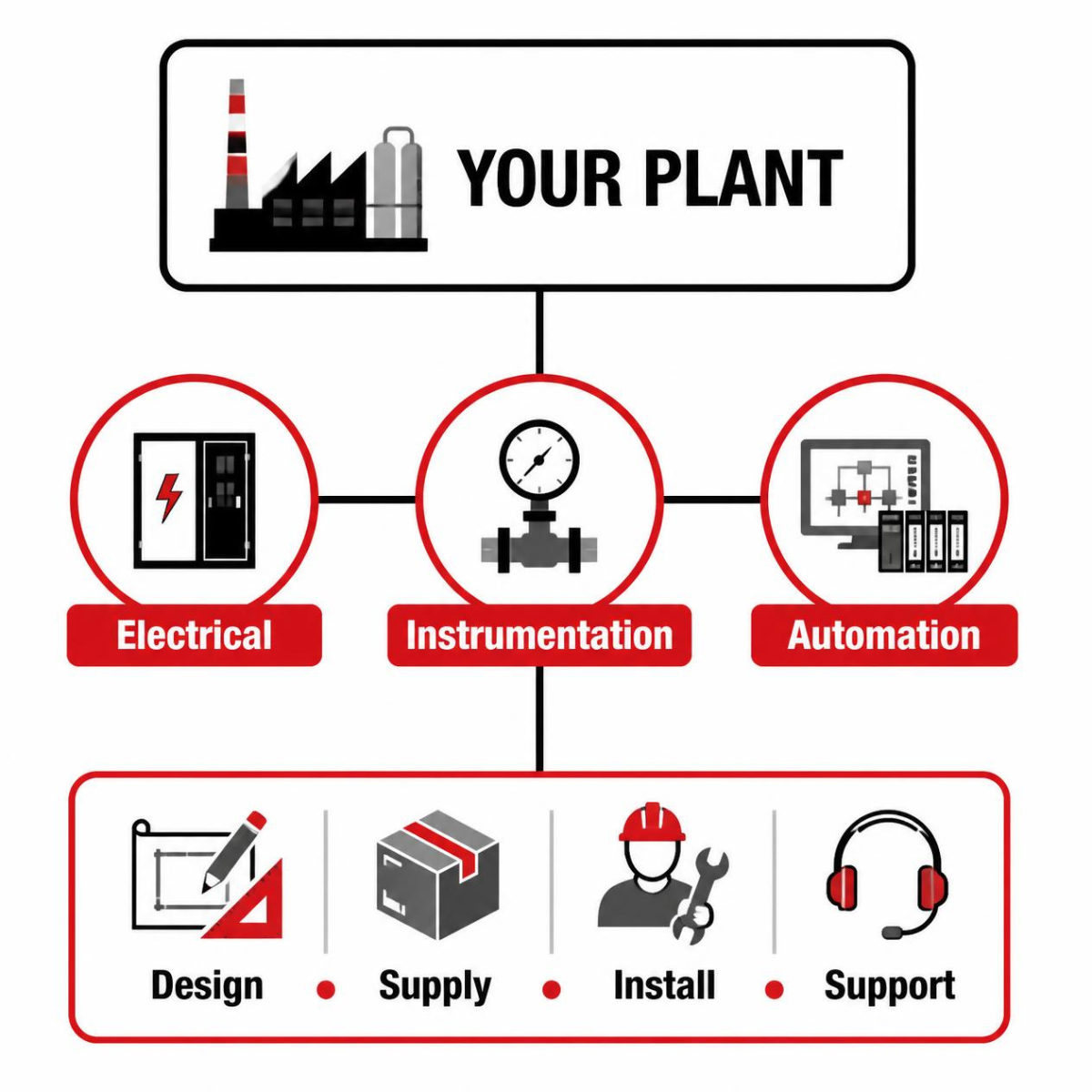
Our engineering team combines instrumentation, electrical engineering and automation expertise to deliver complete process control solutions, including:
- Industrial Instrumentation
- PLC & Control Systems
- SCADA & HMI Development
- Industrial Networking
- Control Panel Design & Manufacturing
- Commissioning & Technical Support
The Core Technologies Behind Every Control System
An effective Process Control & Automation system combines several interconnected technologies, each performing a critical role within the overall operation.
Process Measurement
Every control decision begins with accurate process data. Instruments continuously measure variables such as flow, pressure, level and temperature to provide real-time visibility into plant conditions.
Controllers
Programmable Logic Controllers (PLCs) and Distributed Control Systems (DCS) analyse incoming process information and determine the appropriate control actions required to maintain stable operating conditions.
Final Control Elements
Control valves, actuators, variable speed drives and other control devices automatically adjust the process to achieve the desired operating conditions.
Supervisory Systems
SCADA and HMI platforms provide operators with real-time visualisation, alarms, historical data, reporting and centralised control of plant operations.
Industrial Communication Networks
Reliable industrial communication ensures that instruments, controllers and supervisory systems exchange information quickly and accurately, allowing the entire control system to operate as one integrated solution.
Integrated together, these technologies provide complete visibility, intelligent automation and reliable plant performance across every stage of your operation.
WHY PROCESS CONTROL & AUTOMATION MATTERS
Better Process Control Leads to Better Business Performance
Successful industrial operations are built on consistency. Every production process relies on maintaining critical operating conditions within acceptable limits. When process variables fluctuate unnecessarily, operations become less efficient, equipment experiences greater stress and production quality becomes more difficult to maintain.
Modern Process Control & Automation systems help organisations achieve greater operational consistency by continuously monitoring plant performance and automatically responding to changing operating conditions before they develop into larger operational issues.
This provides measurable improvements across multiple areas of the business.
01
Improved Process Stability
Automated control systems maintain tighter control over critical process variables, reducing unnecessary fluctuations that impact production quality and equipment performance.
02
Increased Plant Reliability
Continuous monitoring allows operators to identify abnormal operating conditions earlier, reducing the likelihood of unexpected failures and supporting proactive maintenance planning.
03
Higher Production Efficiency
Optimised control strategies reduce process variability, minimise waste and improve throughput while helping facilities make better use of available resources.
04
Better Operational Visibility
Operators and engineers gain real-time insight into plant performance through live dashboards, alarms, historical trends and automated reporting, enabling faster and more informed decision-making.
05
Reduced Downtime
Early detection of process deviations and equipment issues helps minimise unplanned shutdowns, reduce maintenance interruptions and improve production availability.
06
Improved Safety
Automation reduces reliance on manual intervention in hazardous operating environments while ensuring critical process parameters remain within safe operating limits.
KEY BENEFITS OF PROCESS CONTROL & AUTOMATION SOLUTIONS
Delivering Measurable Operational and Commercial Value
At Proplant PCE, we believe automation should deliver more than technological advancement—it should create measurable improvements in operational performance, reliability and long-term business value.
01
Commercial Benefits
Effective automation improves overall equipment effectiveness (OEE), reduces production losses, lowers operational costs and helps organisations maximise the return on their capital investments. Greater process consistency also improves product quality and supports stronger profitability.
02
Operational Benefits
Integrated control systems provide greater visibility across the entire production process, allowing operators to respond quickly to changing conditions while maintaining stable and predictable plant performance.
03
Reliability Benefits
Continuous monitoring and intelligent control reduce equipment stress, minimise unnecessary process disturbances and support longer asset life through improved operating conditions.
04
Maintenance Benefits
Automation systems provide valuable operational data that enables predictive and condition-based maintenance strategies. Maintenance teams can identify emerging issues before failures occur, reducing emergency repairs and improving maintenance planning.
05
Safety Benefits
Automated control reduces operator exposure to hazardous environments while ensuring critical safety limits are maintained through alarms, interlocks and automated shutdown strategies where required.
06
Performance Benefits
Ultimately, Process Control & Automation Solutions enable facilities to achieve higher levels of production efficiency, process consistency and long-term operational performance—creating a more resilient operation that is better equipped to meet future production demands.
Engineering Intelligent, Reliable and Efficient Industrial Operations
Type your paragraph hereNo two industrial facilities operate under the same conditions. Every operation has unique production objectives, process challenges and performance requirements. Effective Process Control & Automation therefore requires engineered solutions tailored to the specific application—not a one-size-fits-all approach.
ENGINEERED FOR YOUR PROCESS
At Proplant PCE, we combine industrial instrumentation, electrical engineering and automation expertise to design integrated process control solutions that improve operational reliability, increase process visibility and optimise long-term plant performance.
Whether implementing a new control system, modernising ageing infrastructure or expanding an existing facility, our engineers work closely with clients to develop solutions aligned with production objectives, maintenance strategies and operational goals.
-
Tailored process control solutions
-
Integrated electrical & automation engineering
-
Improved operational visibility
-
Increased plant reliability
-
Reduced operational risk
-
Long-term engineering support
ENGINEERED FOR YOUR PROCESS
Every solution is engineered to provide greater control over critical processes, improve efficiency, reduce downtime and support informed operational decision-making across the plant.
OUR APPROACH TO PROCESS CONTROL
Engineering Solutions Built Around Your Process
Effective automation begins with understanding the process—not selecting equipment.
Before recommending technologies or control strategies, we take the time to understand how your operation functions, where performance constraints exist and what improvements will deliver the greatest operational value.
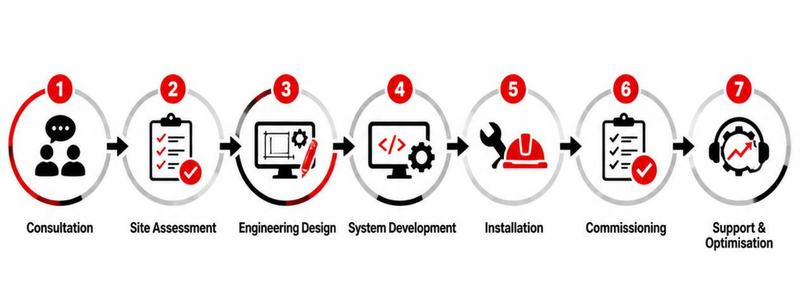
Our engineering approach focuses on five key stages.
STEP 01
Process Assessment
We evaluate existing processes, production requirements, operational challenges and control philosophies to identify opportunities for improved automation, monitoring and process optimisation.
STEP 02
Control Strategy Development
Every industrial process behaves differently. We develop control strategies that maintain stable operating conditions while supporting production efficiency, equipment protection and operational safety.
STEP 03
System Integration
Successful automation relies on seamless communication between instrumentation, control systems and operational software. We integrate these technologies into a unified solution that provides accurate process visibility and dependable control.
STEP 04
Commissioning & Optimisation
Automation systems require careful testing, commissioning and performance verification to ensure they operate as intended. We work with plant teams to optimise system performance and fine-tune control strategies for long-term operational success.
STEP 05
Ongoing Engineering Support
Industrial operations continue to evolve. We provide ongoing technical support and engineering expertise to help clients adapt their automation systems as operational requirements change.
AUTOMATION TECHNOLOGIES
Integrated Technologies for Modern Industrial Operations
Modern Process Control & Automation combines multiple technologies into a single intelligent operating environment. Each technology plays a specific role in monitoring, controlling and optimising industrial processes.
Programmable Logic Controllers (PLCs)
PLCs form the core of most industrial automation systems. They continuously receive information from field instrumentation, execute programmed control logic and communicate with field devices to maintain stable operating conditions. PLC systems provide fast, reliable and repeatable control across manufacturing, mining, utilities, water treatment and processing industries. Typical applications include:
SCADA Systems
Supervisory Control and Data Acquisition (SCADA) platforms provide centralised monitoring and control of industrial operations. Operators gain real-time visibility into process conditions through graphical interfaces, live alarms, historical trends and performance dashboards, enabling faster operational decisions and more efficient plant management. SCADA systems also improve traceability, reporting and operational analysis by collecting valuable process data over extended periods.
Human Machine Interface (HMI)
Human Machine Interfaces allow operators to interact safely and efficiently with industrial processes. Modern HMIs present process information in an intuitive format, enabling operators to:
Industrial Communication Networks
Reliable communication forms the foundation of every automation system. Industrial communication networks ensure accurate data transfer between instruments, controllers, supervisory systems and plant equipment. A robust communication infrastructure enables reliable system integration, faster diagnostics and improved operational visibility across the entire facility.
Building Blocks of an Effective Control System
Successful automation depends on the seamless integration of multiple components working together as one intelligent system.
Field Instrumentation
Field instruments measure the physical conditions within a process. These include:
Controllers
Controllers analyse process measurements and compare them against predefined operating parameters. When deviations occur, the controller automatically determines the appropriate corrective action to maintain process stability.
Final Control Elements
Control valves, actuators, variable speed drives and other final control elements physically adjust the process based on instructions received from the controller. These components regulate flow, pressure, temperature and other process variables to maintain stable operating conditions.
Supervisory Systems
SCADA platforms and HMI software provide centralised monitoring, control and reporting, allowing operators to manage complex industrial processes from a single location.
Engineering Software
Configuration, diagnostics, asset management and engineering software simplify system maintenance, improve troubleshooting and support long-term system reliability.
Supporting Critical Industrial Processes
Process Control & Automation Solutions are used across virtually every industrial sector where reliable, efficient and repeatable operations are essential. Typical applications include:
Water & Wastewater Treatment
Automation improves treatment consistency, optimises chemical dosing, controls pumping systems, monitors water quality and supports regulatory compliance.
Mining Operations
Mining facilities rely on automation to improve material handling, crushing, flotation, pumping, dewatering, tailings management and mineral processing while increasing operational reliability in demanding environments.
Manufacturing Facilities
Automation supports production efficiency, improves product consistency, reduces waste and enables continuous monitoring of manufacturing processes.
Chemical Processing
Accurate process control maintains critical operating conditions during chemical production, improving product quality while supporting safe plant operation.
Food & Beverage Processing
Automated control systems improve product consistency, support hygiene standards, optimise cleaning processes and enhance production efficiency.
Utilities & Energy
Power generation, water distribution and utility infrastructure rely on automation for remote monitoring, operational reliability and efficient asset management.
Bulk Material Handling
Automation controls conveyors, silos, crushers, feeders and transfer systems to improve operational efficiency and reduce equipment wear.
Industrial Utilities
Compressed air systems, steam generation, cooling water circuits and utility infrastructure benefit from continuous monitoring and automated control.
Engineering Solutions Across Southern Africa's Industrial Sector
Proplant PCE supports organisations operating in some of Southern Africa’s most demanding industrial environments. While every industry has unique operational challenges, the objective remains the same—achieving safe, reliable and efficient plant performance. We provide Process Control & Automation Solutions for:
Mining & Mineral Processing
Improve operational reliability, maximise equipment availability and optimise mineral processing through intelligent automation and process control.
Manufacturing
Increase production consistency, reduce waste and improve operational efficiency through integrated automation systems.
Water & Wastewater
Support reliable treatment processes, regulatory compliance and efficient infrastructure management through advanced monitoring and automation.
Chemical Processing
Maintain accurate process control while improving product quality, operational safety and plant stability.
Food & Beverage
Enhance production efficiency, improve traceability and maintain consistent product quality through automated process control.
Energy & Utilities
Improve operational visibility, increase system reliability and support critical infrastructure through integrated automation technologies.
General Industrial Processing
From pulp and paper to cement, metals, agriculture and industrial manufacturing, automation supports safer, more efficient and more reliable operations.
COMMON PROCESS CONTROL CHALLENGES
Why Industrial Automation Projects Fall Short
Many automation projects fail to deliver their expected benefits—not because of the technology itself, but because critical engineering principles are overlooked during system design, implementation or maintenance.
Understanding these common challenges helps organisations make better long-term investment decisions.
Poor Instrument Selection
Even the most advanced automation system cannot perform effectively if inaccurate or unsuitable field instrumentation provides unreliable process data.
Best Practice: Select instrumentation based on the specific process conditions, operating environment and required measurement accuracy—not on cost alone.
Inadequate System Integration
Disconnected systems create information silos, increase maintenance complexity and reduce operational visibility.
Best Practice: Design integrated automation architectures where instrumentation, PLCs, SCADA platforms and field devices communicate seamlessly.
Focusing on Equipment Rather Than Process Outcomes
Purchasing individual components without considering the overall control philosophy often results in inconsistent performance and limited operational improvements.
Best Practice: Begin with the operational objective and develop a control strategy that aligns technology with business outcomes.
Lack of Operator Engagement
Automation systems are only effective when operators understand how to use them efficiently.
Best Practice: Develop intuitive HMI interfaces, provide appropriate training and involve operational personnel throughout implementation.
Limited Maintenance Planning
Ignoring preventative maintenance and system diagnostics can reduce automation reliability over time.
Best Practice: Use diagnostic information, asset management software and predictive maintenance strategies to maximise system performance and equipment life.
Engineering Better Operational Outcomes
Successful Process Control & Automation is not measured by the sophistication of the technology installed. It is measured by the consistency of production, the reliability of plant operations and the value it delivers to the business.
By combining proven automation technologies with practical engineering expertise and a deep understanding of industrial operations, Proplant PCE helps organisations develop intelligent control systems that improve performance today while supporting future operational growth.
Improved Plant
Reliability
Reduce unexpected failures through engineered control systems.
Increased Production Efficiency
Optimise process performance through intelligent automation.
Lower Operational
Costs
Improve maintenance planning and reduce unnecessary downtime
Scalable
Automation
Design systems that support future plant expansion.
WHY CHOOSE PROPLANT PCE
Your Partner in Process Control & Automation Excellence
Selecting the right Process Control & Automation partner is about more than choosing a supplier. It’s about working with an engineering team that understands your processes, your operational challenges and the long-term performance goals of your facility.
At Proplant PCE, we combine technical expertise with practical industry experience to deliver automation solutions that are engineered around your operation—not simply around individual products.
Our approach is collaborative, consultative and focused on achieving measurable operational outcomes.
OUR ENGINEERING PROCESS
Why Businesses Trust Proplant PCE
01
Engineering-Led Solutions
Every automation project begins with understanding the process. We assess your operational requirements, evaluate existing systems and recommend solutions that improve reliability, efficiency and plant performance rather than simply replacing equipment.
02
Practical Industry Experience
Our team understands the operational realities of industrial environments, including mining, manufacturing, water treatment, utilities, chemical processing and food production. We develop solutions that are technically robust, practical to maintain and aligned with your production objectives.
03
Integrated Process Control Expertise
Successful automation depends on the seamless integration of instrumentation, control systems, software and electrical infrastructure. We provide solutions that consider the complete control system, ensuring all components work together to achieve stable, reliable operation.
04
Technology-Neutral Recommendations
Every facility has different operational requirements. Rather than promoting a one-size-fits-all solution, we recommend technologies based on process conditions, application requirements, lifecycle costs and long-term operational value.
05
Long-Term Engineering Support
Automation systems continue to evolve throughout their operational life. We support our clients beyond project completion through technical guidance, system optimisation, troubleshooting and ongoing engineering assistance.
06
A Focus on Operational Outcomes
Our goal is not simply to install automation systems. Our goal is to help clients:
Because successful automation is measured by operational performance—not by the technology installed.
industry Experience
FAQs
Frequently Asked Questions About Process Control & Automation Solutions
Process Control & Automation is the use of instrumentation, sensors, controllers, software and automated control systems to monitor, regulate and optimise industrial processes. By maintaining critical process variables such as flow, pressure, level and temperature within defined operating limits, automation improves operational stability, production efficiency and plant reliability.
Effective process control helps organisations reduce process variability, minimise downtime, improve product quality, increase equipment reliability and optimise production efficiency. It also enables operators to respond more quickly to changing process conditions through real-time monitoring and automated control.
Process Control & Automation is used across a wide range of industries, including:
- Mining & Mineral Processing
- Water & Wastewater Treatment
- Manufacturing
- Chemical Processing
- Food & Beverage
- Energy & Utilities
- General Industrial Processing
Any operation that relies on consistent, safe and efficient production can benefit from modern automation technologies.
Process Control focuses on maintaining stable operating conditions by continuously monitoring and controlling process variables. Industrial Automation is the broader application of technologies such as PLCs, SCADA systems, HMIs and communication networks to automate industrial operations. Together, they create intelligent systems that improve operational performance and reduce manual intervention.
PLCs collect information from field instrumentation and execute control logic to manage equipment and processes. SCADA systems provide operators with a centralised interface to monitor, visualise and control those processes while storing historical data, generating reports and managing alarms.
An automation system should be evaluated when organisations experience increasing downtime, obsolete equipment, limited process visibility, poor production consistency, recurring maintenance issues or difficulties integrating new technologies. Modernisation can improve reliability, operational efficiency and long-term maintainability.
Automation systems provide continuous operational data that supports predictive and condition-based maintenance. By identifying abnormal equipment behaviour before failures occur, maintenance teams can plan repairs more effectively, reduce emergency breakdowns and extend asset life.
Selecting the right solution requires evaluating process objectives, operating conditions, existing infrastructure, maintenance requirements, future expansion plans and lifecycle costs. Working with an experienced engineering partner helps ensure the solution aligns with both operational and commercial goals.
In many cases, yes. Modern automation solutions can often be integrated with existing PLCs, SCADA platforms, instrumentation and electrical systems. The most effective approach depends on the condition, compatibility and long-term objectives of the existing infrastructure.
Proplant PCE combines engineering expertise, industrial automation knowledge and process control experience to deliver practical solutions tailored to each client’s operational requirements. Our focus extends beyond equipment supply to improving plant reliability, operational efficiency and long-term process performance.
Industrial Automation is the use of control systems, instrumentation, software and intelligent equipment to monitor, control and optimise industrial processes with minimal manual intervention. Automation technologies such as PLCs, SCADA systems, sensors, control valves and industrial communication networks work together to improve operational efficiency, increase production consistency, reduce downtime and enhance workplace safety. At Proplant PCE, we design and integrate industrial automation solutions that help businesses improve plant performance while supporting long-term operational reliability.
Process Control is the continuous monitoring and regulation of industrial processes to maintain safe, stable and efficient operations. By measuring variables such as pressure, temperature, flow and level, control systems automatically adjust equipment to keep processes operating within predefined limits. Effective process control improves product quality, reduces waste, minimises downtime and increases operational efficiency. Proplant PCE designs integrated process control solutions tailored to each client’s operational requirements.
SCADA (Supervisory Control and Data Acquisition) is a software platform that allows operators to monitor, control and analyse industrial processes from a central location. SCADA systems display real-time process data, alarms, trends and historical information, enabling operators to respond quickly to changing plant conditions. When integrated with PLCs and field instrumentation, SCADA improves operational visibility, supports informed decision-making and enhances overall plant performance.
Industrial automation is used across almost every processing and manufacturing industry. Common applications include mining, mineral processing, manufacturing, water and wastewater treatment, food and beverage production, power generation, utilities, agriculture, chemical processing, pharmaceuticals and infrastructure. Automation improves productivity, operational safety, process consistency and equipment reliability regardless of industry.
Yes. Many ageing PLC systems can be upgraded without replacing the entire control system. Modernisation may include replacing obsolete controllers, upgrading software, improving communication networks, integrating SCADA systems or migrating to newer automation platforms. Proplant PCE evaluates existing infrastructure and recommends practical upgrade strategies that minimise downtime while improving reliability, maintainability and future scalability.
Commissioning time depends on the size and complexity of the project. Small automation systems may be commissioned within a few days, while larger plant-wide automation projects can require several weeks. The commissioning process includes equipment testing, control logic verification, instrument calibration, system integration, functional testing and operator training. Proplant PCE carefully plans commissioning activities to minimise disruption to production.
Yes. Proplant PCE provides integrated electrical engineering solutions that complement process control and automation systems. Our services include electrical design, motor control centres (MCCs), control panels, power distribution, field installation, commissioning and system integration. Combining electrical engineering with automation ensures reliable and efficient industrial operations.
Motor Control Centre (MCC) design involves engineering electrical panels that safely distribute power and control electric motors throughout an industrial facility. MCCs typically include motor starters, protection devices, variable speed drives, PLC interfaces and monitoring equipment. Well-designed MCCs improve equipment reliability, simplify maintenance and support efficient plant operation.
Yes. Many industrial facilities contain equipment from multiple manufacturers and different generations of technology. Proplant PCE specialises in integrating new automation systems with existing PLCs, instrumentation, electrical infrastructure and communication networks wherever practical. Our objective is to maximise the value of existing assets while improving overall system performance.
Yes. Proplant PCE supports industrial clients throughout South Africa. Our engineering team delivers process control, electrical engineering, instrumentation and automation solutions across a wide range of industries, providing engineering support from project planning and system design through installation, commissioning and ongoing technical support.
Proplant PCE works with a wide range of internationally recognised industrial automation, instrumentation and electrical equipment manufacturers. Our technology-neutral approach allows us to recommend the most appropriate solution for each application rather than promoting a single supplier. This ensures every system is designed around operational requirements, long-term reliability and lifecycle value.
Predictive maintenance uses real-time operational data, condition monitoring and equipment diagnostics to identify potential failures before they cause unplanned downtime. By continuously monitoring equipment performance, maintenance activities can be scheduled proactively, reducing repair costs, extending equipment life and improving plant reliability.
Yes. Properly designed automation systems continuously monitor equipment, detect abnormal operating conditions and respond automatically to prevent process disruptions. Improved visibility, alarm management, predictive diagnostics and reliable control strategies help reduce unplanned downtime while improving productivity and operational efficiency.
The cost of an industrial automation project depends on factors such as plant size, system complexity, equipment requirements, integration needs and project scope. Every facility has different operational requirements, so costs vary significantly between projects. Proplant PCE assesses each application individually and develops engineered solutions that deliver measurable operational value while remaining aligned with the client’s budget and objectives.
Commissioning is the process of verifying that an automation system performs as designed before it enters normal operation. Activities typically include equipment inspection, instrument calibration, PLC and SCADA testing, communication verification, functional testing, operator training and final performance validation. Successful commissioning ensures safe, reliable and efficient plant operation from day one.
Common signs include frequent equipment failures, obsolete PLC hardware, unsupported software, poor system visibility, increasing maintenance costs, communication problems, limited spare parts availability and difficulty integrating new technologies. If your automation system no longer supports your operational objectives or creates unnecessary downtime, an engineering assessment can identify practical upgrade opportunities that improve reliability, efficiency and long-term maintainability.
Ready to Improve Your Process Control?
Let's Build a More Reliable, Efficient and Future-Ready Operation
Whether you’re planning a new automation project, upgrading an existing control system or looking to improve operational performance, Proplant PCE can help.
Our engineering team works with plant managers, process engineers, maintenance teams and project specialists to develop automation solutions that support reliable production, improved process visibility and long-term operational success.
From system design and equipment selection to integration, commissioning and ongoing technical support, we’re committed to helping you achieve better process control and measurable operational outcomes.