Industrial Instrumentation Solutions in South Africa
Accurate process measurement starts with reliable instrumentation.
Proplant PCE selects, supplies, installs and calibrates industrial instrumentation for mines, smelters and process plants in South Africa.
What is industrial instrumentation?
Industrial instrumentation is the set of field devices that measure process conditions such as flow, level, pressure, temperature and density, and send those measurements to a control system.
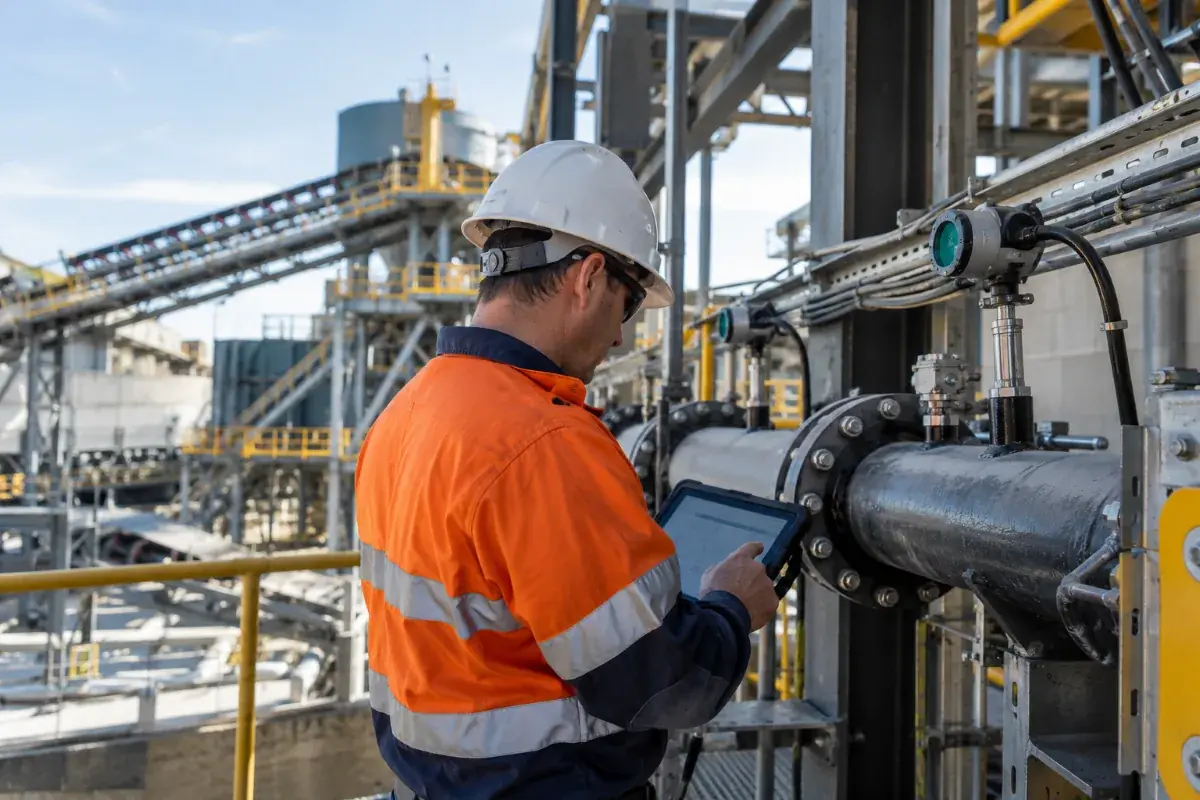
From our base in Middelburg, Mpumalanga, our electrical and instrumentation team covers flow, level, pressure, temperature and non-nuclear density measurement, from a single replacement transmitter to a full plant upgrade.
Each measurement point usually has a sensor in contact with the process, a transmitter that turns the reading into a 4 to 20 mA, HART, Modbus or IO-Link signal, and the cabling that carries it to a PLC, SCADA or DCS.
If the measurement is wrong, every control decision built on it is wrong too.
That is why instrument selection, installation and calibration matter as much as the instrument itself.
When process measurements become inaccurate, delayed or unreliable, the consequences extend far beyond a single instrument.
Every automated industrial process begins with measurement.
Before a control system can regulate a pump, adjust a valve or maintain a process within safe operating limits, it must first receive accurate information from field instrumentation.
The cost of poor process measurement
- Unstable production
- Reduced product quality
- Unnecessary energy consumption
- Equipment damage
- Increased maintenance costs
- Costly unplanned downtime
Measurement solutions for critical process variables
Proplant PCE supplies a comprehensive range of instrumentation solutions for monitoring and controlling critical process variables.
Flow measurement
Instruments that monitor the movement of liquids, gases and steam throughout industrial processes. Essential for production control, batching, chemical dosing, custody transfer, energy management and process optimisation.Pressure measurement
Pressure transmitters and sensors provide continuous monitoring of pipelines, vessels, pumps, compressors and process systems to protect equipment and maintain process stability.Level measurement
Measures liquid, slurry and solid levels within tanks, silos, hoppers and storage vessels. Reliable level measurement prevents overflow, dry running, inventory losses and production interruptions.Temperature measurement
Maintains product quality, protects equipment and ensures safe operating conditions across manufacturing, mining, food production, chemical processing and energy generation.Non-nuclear density measurement
Enables operators to monitor product concentration, process consistency and material quality in real time. Widely used in mining, mineral processing, chemical production and slurry applications.Control valves and actuation
The final control element in many industrial automation systems. Working alongside PLCs, DCS and field instrumentation, they automatically regulate the flow of liquids, gases and steam to maintain stable process conditions.Sensors and transmitters
Sensors detect physical process conditions and convert them into measurable signals. Transmitters convert those measurements into standardised electrical or digital signals for PLCs, SCADA systems or distributed control systems.Switches, indicators and displays
Pressure, level and temperature switches provide simple on/off control or alarm functions. Local indicators give operators immediate access to process information at field level.Signal conditioning, calibration and diagnostics
Signal converters, communication gateways and interface modules enable integration with industrial control systems. Self-diagnostics and regular calibration help maintain measurement accuracy throughout the instrument's operational life.Every reliable control decision begins with accurate measurement.
Process instrumentation for continuous industrial processes
Process instrumentation is industrial instrumentation applied to a running process: pipelines, tanks, silos, furnaces, conveyors and slurry circuits where the reading feeds a control loop, an alarm or a production record.
Primary measurement
The sensor or element in the process, chosen for the medium, temperature, pressure and installation space.
Transmission
Transmitters and signal converters that deliver a stable signal to the control system.
Local indication and switching
Indicators, displays and switches for operators and simple alarms at field level.
Final control elements
Control valves and actuators that act on the measurement.
Verification
Loop checks, calibration and flow meter verification so the reading in the control room matches the process.
Read more
The terms are often used interchangeably. In practice, process instrumentation work starts from the process conditions, not from a product catalogue.
The operational benefits of accurate process measurement
Continuous measurement provides operators with a real-time understanding of plant conditions, enabling faster responses to changing process demands.
High-quality instrumentation delivers dependable measurements that improve process consistency, product quality and operational confidence.
Reliable process data enables engineering, production and maintenance teams to make informed decisions based on actual plant conditions rather than assumptions.
Monitoring critical process variables helps prevent equipment from operating outside acceptable limits, reducing wear and extending asset life.
Accurate instrumentation monitors critical operating conditions, triggers alarms and helps prevent unsafe process situations before they escalate.
Consistent measurement supports stable control strategies, enabling production processes to operate efficiently while reducing unnecessary process variability.
The right instrument for the right application
We assess your process, identify the variables that need to be monitored and evaluate the environmental and operational conditions that influence measurement performance.
Based on your application requirements, we recommend instrumentation technologies that provide the required level of accuracy, reliability and long-term performance.
Instrumentation should integrate seamlessly with existing PLCs, SCADA systems, Distributed Control Systems (DCS) and plant monitoring platforms.
Correct installation is essential for accurate measurement.
We provide guidance and engineering support to help ensure instruments are installed, configured and commissioned correctly.
We continue to support our clients through troubleshooting, optimisation, replacement recommendations and technical assistance throughout the operational life of their assets.
Matching the instrument to the process variable
Each process variable has its own measurement technologies, and the conditions at the measurement point decide which one fits.
Flow
Typical technologies: electromagnetic, Coriolis, averaging pitot (differential pressure) and thermal meters.
The choice depends on conductivity, mass or volume, pipe size, gas or steam, and the straight run available. See our flow measurement range.
Level
Typical technologies: radar, ultrasonic, hydrostatic, capacitive and microwave.
The choice depends on liquid, slurry or solids, dust, foam, vessel shape and temperature. See our level measurement range.
Pressure
Typical technologies: pressure transmitters, differential pressure transmitters, diaphragm seals and IO-Link pressure sensors with switch outputs.
The choice depends on the media, temperature, vibration and hazardous area. See our pressure measurement range.
Temperature
Typical technologies: PT100 and RTD sensors, thermocouples including furnace thermocouples, and temperature transmitters.
The choice depends on temperature range, response time, mounting and signal. See our temperature measurement range.
Density
Typical technologies: non-nuclear ultrasonic density meters such as the Rhosonics SDM ECO.
The choice depends on slurry type, solids content, pipe size and whether a radioactive source is being removed. See our density measurement range.
The foundation of every process control system
Industrial instrumentation forms the first layer of every Process Control & Automation system by providing continuous feedback from the process itself.
What control systems can do
This information enables control systems to detect process changes, monitor operating conditions, trigger alarms and adjust equipment automatically.
It also lets them record historical process data, support predictive maintenance and improve operational decision-making.
What is continuously monitored
Using specialised measuring devices, industrial instrumentation continuously monitors conditions such as non-nuclear density, position, process status and equipment condition.
These measurements are transmitted to control systems, PLCs, SCADA platforms and operators, allowing industrial processes to be monitored in real time and adjusted whenever operating conditions change.
Without accurate instrumentation
Industrial control systems cannot make informed decisions, operators lose visibility into plant performance and process reliability begins to decline.
Read more
Reliable instrumentation transforms physical process conditions into actionable operational intelligence. Without it, effective automation is impossible.
Industrial Instrumentation is the science and engineering of measuring, monitoring and transmitting information about critical process variables within an industrial operation. Instrumentation provides the accurate process data required to operate equipment safely, maintain production quality and optimise plant performance.
Reliable measurement creates better business outcomes
Instrumentation is often viewed simply as the devices installed throughout a plant.
Commercial benefits
Reliable instrumentation reduces production losses, improves product consistency and supports more efficient use of raw materials, energy and utilities.
By minimising process variability and reducing operational inefficiencies, organisations can improve profitability while protecting long-term capital investments.
Operational benefits
Real-time measurement enables continuous monitoring of critical process conditions, providing operators with greater visibility into plant performance and allowing faster responses to operational changes.
Reliability benefits
Accurate instrumentation helps maintain stable operating conditions, reduces unnecessary equipment stress and supports more consistent process control.
Reliable measurements contribute directly to improved plant availability and long-term operational reliability.
Maintenance benefits
Modern instrumentation provides valuable diagnostic information that enables condition-based maintenance and faster fault identification.
Maintenance teams can detect developing issues earlier, improve maintenance planning and reduce unexpected equipment failures.
Safety benefits
Instrumentation plays a critical role in maintaining safe operating conditions by continuously monitoring key process variables, supporting alarm management and enabling rapid response to abnormal operating conditions.
Performance benefits
Industrial Instrumentation Solutions provide the reliable process information needed to improve production efficiency, strengthen process control and support data-driven operational improvement across the entire facility.
Effective instrumentation empowers organisations to operate with greater confidence, improve decision-making and achieve long-term operational performance.
Read more
In reality, it is one of the most valuable sources of operational intelligence within an industrial facility.
Accurate, dependable measurements enable organisations to optimise production, reduce risk and make better engineering decisions throughout the lifecycle of their operations.
Industrial process instrumentation in mining and mineral processing
Mining and smelting is Proplant’s core sector.
Process monitoring
Continuous monitoring of process variables provides operators with real-time visibility into plant performance, enabling faster operational decisions and improved process control.
Equipment protection
Instrumentation protects pumps, compressors, boilers, pipelines and other critical assets by monitoring operating conditions and providing early warning of abnormal process behaviour.
Process optimisation
Reliable measurement enables engineers to optimise production processes, reduce waste, improve product quality and maximise equipment efficiency.
Energy management
Instrumentation supports monitoring of utilities, compressed air, steam, fuel consumption and energy usage, helping organisations improve operational efficiency and reduce operating costs.
Environmental and regulatory compliance
Accurate measurement supports environmental monitoring, emissions reporting and compliance with operational standards and regulatory requirements.
Asset performance monitoring
Continuous process data enables predictive maintenance strategies, allowing maintenance teams to identify developing equipment issues before failures occur.
Mining and mineral processing
Reliable measurement supports crushing, flotation, slurry transport, thickening, tailings management, pumping systems and mineral processing operations.
Water and wastewater
Instrumentation enables accurate monitoring of treatment processes, pumping stations, chemical dosing systems and distribution networks.
Manufacturing
Manufacturing facilities rely on accurate instrumentation to maintain product quality, improve production efficiency and reduce process variability.
Chemical processing
Continuous measurement of flow, pressure, temperature and level supports safe production, process consistency and regulatory compliance.
Food and beverage
Reliable instrumentation helps maintain hygiene standards, improve traceability and ensure consistent product quality throughout production.
Energy and utilities
Power generation and utility infrastructure depend on accurate process measurements to maintain operational stability and maximise equipment availability.
General industrial processing
From pulp and paper to cement, metals, agriculture and heavy industry, instrumentation provides the reliable process data required to improve operational performance.
Read more
Typical work includes slurry density measurement with non-nuclear meters, furnace thermocouples and temperature measurement on smelter plant, level measurement on silos, sumps and chutes, belt scale installation and calibration on conveyors, and pressure and flow measurement on pumping systems. Each application is reviewed against the actual process conditions before an instrument is recommended.
Industrial Instrumentation is used wherever accurate process information is required to maintain safe, efficient and reliable operations.
Industrial Instrumentation is essential wherever accurate measurement influences operational performance. Proplant PCE provides instrumentation solutions for a wide range of industrial sectors throughout Southern Africa.
Getting measurement right the first time
Even the highest-quality instrumentation can fail to deliver reliable results if it is incorrectly selected, installed or maintained.
Selecting the wrong measurement technology
Best practice: Evaluate the complete application, including process media, operating conditions, accuracy requirements and environmental factors, before selecting instrumentation.
Poor installation practices
Best practice: Follow manufacturer installation guidelines and consider factors such as mounting position, straight pipe requirements, vibration, temperature and accessibility.
Neglecting calibration
Best practice: Establish a structured calibration programme based on criticality, operating conditions and regulatory requirements to maintain confidence in process data.
Limited diagnostic monitoring
Best practice: Use built-in diagnostics and digital communication capabilities to identify developing issues early and support predictive maintenance strategies.
Failing to consider future expansion
Best practice: Choose scalable instrumentation that integrates easily with existing and future control systems.
Read more
Understanding these common challenges helps organisations improve measurement accuracy and maximise long-term return on investment.
Why businesses trust Proplant PCE
Selecting the right instrumentation partner involves more than sourcing measurement devices.
Engineering expertise that supports better decisions
Every application presents unique challenges.
Our engineering team evaluates the complete application before recommending a solution, helping clients select instrumentation that delivers dependable performance under real operating conditions.
Practical industry experience
From abrasive mining slurries and corrosive chemicals to high-pressure steam systems and hygienic food processing applications, we understand the factors that influence long-term measurement reliability.
This practical knowledge enables us to recommend solutions that are not only technically correct but also practical to install, maintain and operate.
Integrated engineering support
We work closely with engineering and operations teams to ensure instrumentation communicates seamlessly with PLCs, SCADA platforms, Distributed Control Systems (DCS) and plant monitoring systems.
The result is improved operational visibility and more reliable process control.
Long-term technical partnership
Whether upgrading instrumentation, expanding production capacity or modernising automation systems, our team provides ongoing engineering support to help clients maintain reliable process measurement as operational requirements change.
Application-focused instrument selection
Our recommendations are based on the complete application, considering process conditions, media characteristics, environmental factors, installation requirements, accuracy requirements, long-term maintenance considerations, integration with existing control systems and total lifecycle value.
This approach helps reduce technical risk while improving operational confidence.
Focused on operational performance
Reliable instrumentation contributes directly to more accurate process control, improved production efficiency, reduced operational risk, better asset protection, increased plant reliability, smarter maintenance planning and improved operational visibility.
Accurate measurement doesn't simply improve instrumentation performance. It improves business performance.
Read more
It requires working with a team that understands industrial processes, application requirements and the operational challenges that influence long-term plant performance.
Our focus extends beyond supplying equipment. We work with clients to develop instrumentation solutions that align with operational objectives, maintenance strategies and future automation requirements.
Reliable instrumentation for critical industrial applications
Why measurement performance often falls short
01Selecting the wrong measurement technology
Choosing an instrument based solely on price or familiarity can result in poor accuracy, increased maintenance and unreliable process data.
02Poor installation practices
Incorrect installation can introduce measurement errors, reduce instrument life and compromise process reliability.
03Neglecting calibration
Over time, measurement accuracy can drift due to process conditions, wear or environmental influences.
04Limited diagnostic monitoring
Modern intelligent instrumentation provides valuable diagnostic information that is often overlooked.
05Failing to consider future expansion
Selecting instrumentation without considering future automation, communication protocols or plant expansion can increase upgrade costs later.
Frequently asked questions
What are the best instruments for process control in industrial applications?
There is no single best instrument. The right one depends on the process variable and the conditions at the measurement point. As a guide: electromagnetic flow meters suit conductive liquids and slurries; Coriolis meters suit mass flow, density and non-conductive liquids; averaging pitot tubes suit gas, steam and large pipes; radar suits level in dusty silos and tanks; PT100 sensors suit general temperature measurement and thermocouples suit furnace temperatures; and non-nuclear ultrasonic meters suit slurry density. Selection should also check accuracy, signal type, hazardous area rating and how the instrument will be maintained.
Is upgrading instrumentation worth the investment for plant performance?
It is worth it when an existing measurement is limiting control, safety or production: readings operators do not trust, loops running in manual, frequent recalibration or failures, obsolete models without spares, or a need for diagnostics the old device cannot give. It is not worth it when the instrument is sound and the fault is installation, calibration or configuration, which cost less to fix. A review of each measurement point shows which case applies before money is spent.
What is the difference between process instrumentation and industrial instrumentation?
Industrial instrumentation is the broad term for measurement and control devices used in industry. Process instrumentation is the same equipment applied to a continuous process, such as a slurry circuit, furnace or water treatment line, where the measurement feeds a control loop. Most suppliers and engineers use the terms interchangeably.
What process variables are commonly measured?
Flow, level, pressure and temperature are the four most common. Density is common in mining and mineral processing, and analytical variables such as pH and conductivity are measured where water or chemical quality matters. The right set depends on the process and how the data is used.
What industries rely on industrial instrumentation?
Mining and mineral processing, smelting, water and wastewater treatment, metals processing, cement, agriculture and general industrial manufacturing all rely on it. Proplant’s core sector is mining and smelting.
How do I choose the right industrial instrument?
Selecting the correct instrument depends on process media, operating pressure, measurement range, required accuracy, installation location, environmental conditions, communication protocols and maintenance requirements. A thorough application assessment helps ensure the most suitable technology is selected.
How often should industrial instruments be calibrated?
Calibration frequency depends on the application's criticality, regulatory requirements, operating conditions and manufacturer recommendations. Critical process measurements may require more frequent verification, while less critical applications may follow longer intervals as part of a planned maintenance programme.
What causes inaccurate process measurements?
Common causes include incorrect instrument selection, poor installation, sensor contamination, process build-up, mechanical damage, calibration drift, electrical interference and extreme environmental conditions. Regular inspection, maintenance and calibration help maintain measurement accuracy.
Can new instrumentation be integrated with existing control systems?
Yes. Modern industrial instrumentation is designed to communicate with PLCs, SCADA systems, Distributed Control Systems (DCS) and other industrial control platforms using a range of standard industrial communication protocols.
What is the relationship between instrumentation and process control?
Instrumentation measures the process. Process control uses that measurement information to automatically regulate and optimise industrial operations. Without reliable instrumentation, process control systems cannot make accurate control decisions.
Explore our other solutions

Ready to improve your process measurement?
Whether you're upgrading existing instrumentation, planning a new project or looking to improve measurement accuracy across your facility, Proplant PCE provides the engineering expertise and instrumentation solutions to help you make informed decisions.