
Industrial pressure measurement for liquids, gases and steam
Gauge, absolute and differential pressure transmitters and IO-Link pressure sensors, selected for the medium, the pressure range and the control system they report to. Supplied, installed and integrated by Proplant PCE.
Pressure measurement you can rely on
A pressure reading starts and stops pumps, trips compressors, protects vessels and tells you when a filter is blocking. Many level and flow readings are worked out from pressure too.
The medium, temperature, pressure peaks and the type of pressure measurement (gauge, absolute or differential) decide which instrument and range will work.
- Pumps run dry or dead-headedLow suction or high discharge pressure that goes unnoticed damages seals, bearings and impellers.
- Blocked filters missedA rising pressure drop across a filter or strainer is the first sign it needs cleaning.
- Sensors destroyed by spikesA range chosen too small is damaged by the first pressure spike or water hammer.
- Level and flow readings wrongTank level and DP flow are worked out from pressure, so any pressure error carries straight through.
Which range should you choose?
Normal pressure sits at 60 % of the range, with room for the spikes.
Illustrative check using standard ranges: the smallest range that covers the highest pressure, and the error as accuracy class × full scale. It is not a selection. Send us your figures and we will confirm the range and the overload rating.Check my applicationThree ways to measure pressure
Pick a type to see how it works, where it fits, what to check, and which instruments in our range use it.
- How it works
- Process pressure flexes a stainless steel diaphragm. Silicone oil carries it to a silicon chip, where four resistors in a Wheatstone bridge change value, and the electronics turn the bridge signal into 4 to 20 mA, voltage or RS485.
- Typically used for
- Line, pump and vessel pressure on water, oil, gas and steam (with a condensation bend), with a local reading on the display.
- Check before you choose
- Choose the range to cover the highest pressure, including spikes, and check the medium temperature at the transmitter.
- In our range
- ALL-P-P400 pressure transmitter
- How it works
- Two process pressures act on two isolating diaphragms. The fill fluid carries both to a central sensor that measures only the difference, so the line pressure cancels out.
- Typically used for
- Flow across an orifice plate or pitot tube, level in closed tanks, density, and the pressure drop across filters and heat exchangers.
- Check before you choose
- Check the span, the static (line) pressure rating and whether you need linear or square root output.
- In our range
- ALL-DP-2051 differential pressure transmitter
- How it works
- A measuring cell turns pressure into a signal that is shown on the display. Switch outputs turn on at the switch point and off at a lower reset point, while an analogue output and IO-Link send the actual value.
- Typically used for
- Hydraulics, lubrication, compressed air, cooling circuits and pump protection on machines, replacing a mechanical pressure switch and gauge.
- Check before you choose
- Check the range, overload and burst pressure, the switching logic (PNP or NPN) and whether the PLC has IO-Link.
- In our range
- Balluff BSP00Y4 IO-Link pressure sensor
Three pressure instruments, one spec sheet
Pick an instrument to see the specifications engineers ask for first, and download its data sheet.
ALL-P-P400 pressure transmitterAllpronix · Gauge and absolute pressure transmitter with display
A compact stainless steel pressure transmitter with an LCD display, for gauge, absolute and sealed pressure from vacuum to 600 bar.
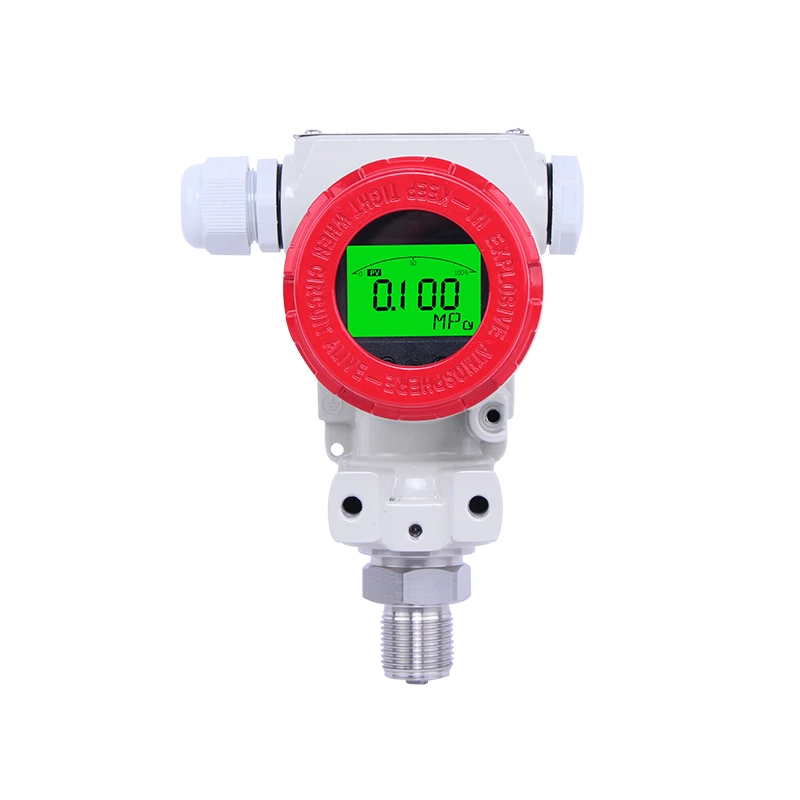
- Range
- -1 to 600 bar
- Accuracy
- 0.2%, 0.25% or 0.5% class
- Output
- 4 to 20 mA, 0 to 10 V, 1 to 5 V, RS485
- Connection
- M20×1.5, G1/2, G1/4, NPT
- Medium
- -20 to 85 °C
- Protection
- IP65, 9 to 32 V DC
Process lines, pumps, water distribution, oil, chemical and steam service with a condensation bend.
ALL-DP-2051 differential pressure transmitterAllpronix · High-accuracy DP transmitter with HART
A differential pressure transmitter for flow, level, density and filter monitoring, with HART and static ratings up to 40 MPa.
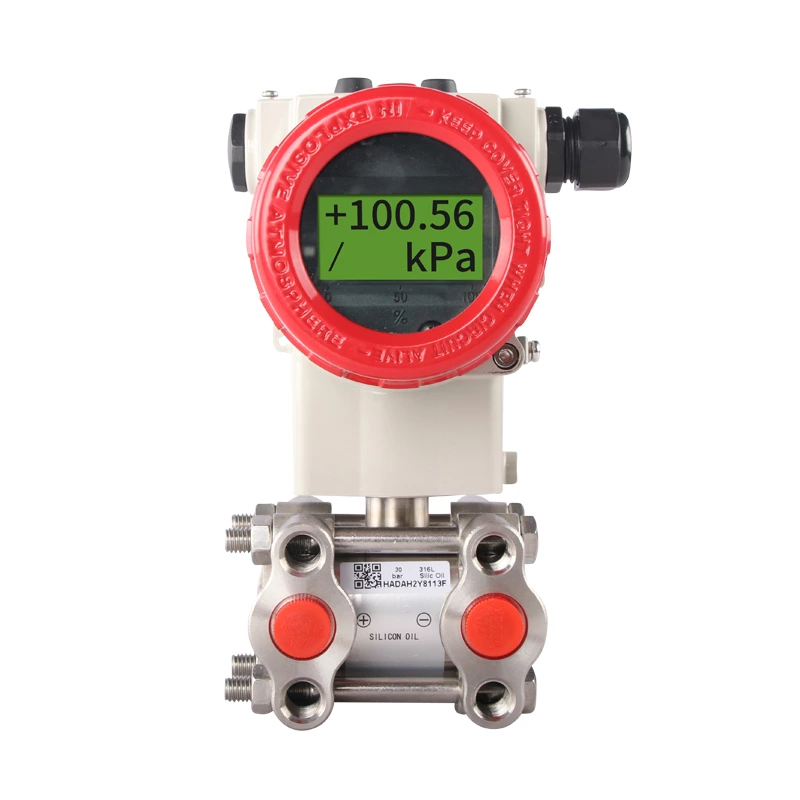
- Spans
- 0.2 kPa to 3 MPa
- Accuracy
- ±0.075% or ±0.1% of span
- Output
- 4 to 20 mA + HART, linear or √
- Static pressure
- 16, 25 or 40 MPa
- Wetted
- 316L, Hastelloy C, tantalum
- Protection
- IP67, 12 to 42 V DC
Orifice and pitot flow, closed-tank level, filter monitoring, chemical, power and water plants.
Balluff BSP00Y4 IO-Link pressure sensorBalluff · Pressure sensor with display, switch outputs and IO-Link
A 0 to 10 bar electronic pressure sensor with a red display, two outputs and IO-Link 1.1, in a stainless steel housing.
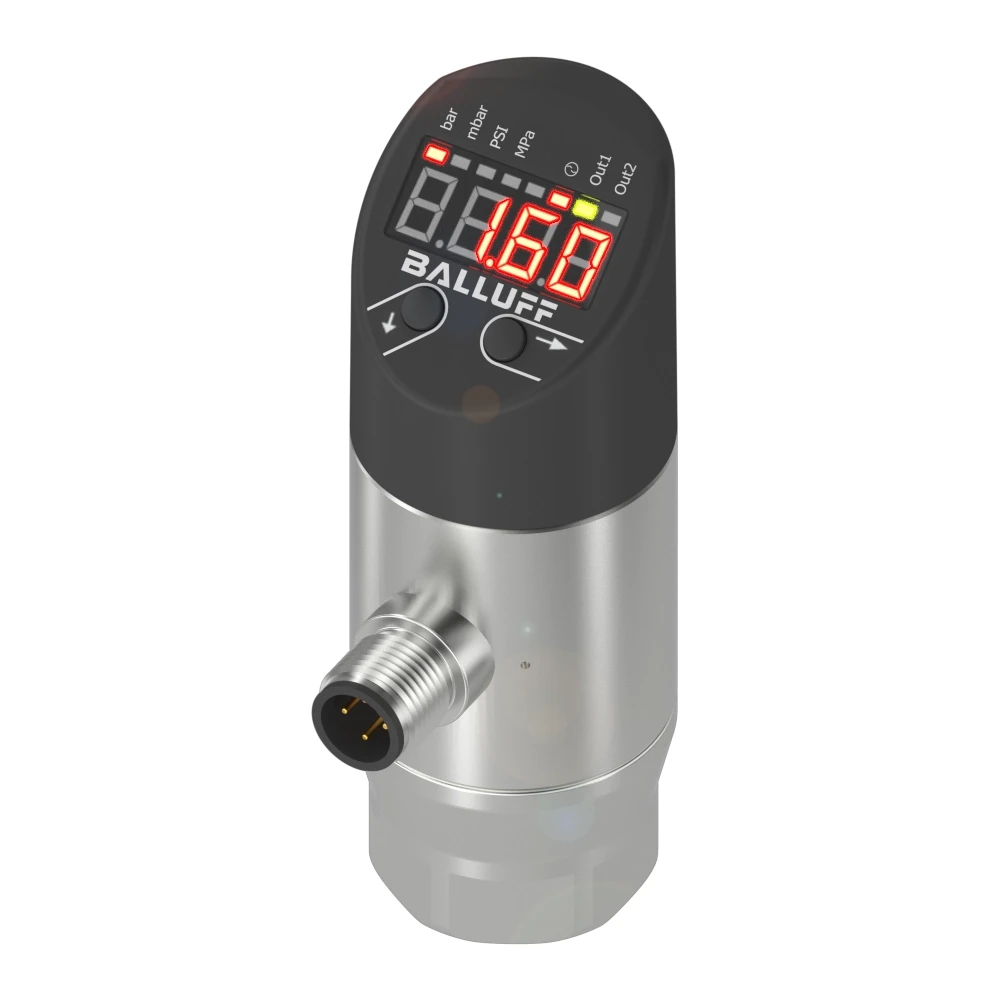
- Range
- 0 to 10 bar (overload 20 bar)
- Accuracy
- ±0.5% FSO BFSL
- Output
- IO-Link, 2 × PNP/NPN, 4 to 20 mA or 0 to 10 V
- Connection
- G1/4, M12 4-pin
- Medium
- -40 to 125 °C
- Protection
- IP67, 18 to 30 V DC
Hydraulics, lubrication, compressed air, cooling circuits and pump protection on machines.
Compare the range
Swipe the table sideways on a phone.
| Instrument | Principle | Range | Output | Supply | Protection |
|---|---|---|---|---|---|
| Gauge and absolute pressure | |||||
| ALL-P-P400 pressure transmitter | Piezoresistive (diffused silicon) | -1 to 600 bar (-0.1 to 60 MPa) | 4 to 20 mA, 0 to 10 V, 1 to 5 V, RS485 | 9 to 32 V DC | IP65 |
| Differential pressure | |||||
| ALL-DP-2051 differential pressure transmitter | Differential pressure (silicon sensor) | Spans 0.2 kPa to 3 MPa, static to 40 MPa | 4 to 20 mA + HART, linear or square root | 12 to 42 V DC | IP67 |
| Pressure sensor with switch outputs | |||||
| Balluff BSP00Y4 IO-Link pressure sensor | Ceramic measuring cell | 0 to 10 bar | IO-Link, 2 × PNP/NPN, 4 to 20 mA or 0 to 10 V | 18 to 30 V DC | IP67 |
What to tell us so we can recommend an instrument
Send us the medium, pressure range, peaks, temperature, connection and required output, and our team will recommend a suitable pressure instrument.
From selection to a working signal in your control system
A pressure transmitter is only as useful as the signal that reaches the control room. We handle the steps around the instrument as well as the instrument itself.
We check the medium, pressure range, peaks, temperature, process connection and output before recommending an instrument.
Instruments from the brands on this page, with datasheets and calibration certificates for your engineering file.
Mechanical installation, impulse lines, manifolds, cabling and termination by our E&I team.
Signal wiring and configuration into your PLC or SCADA, including HART, IO-Link masters and Siemens systems.
Frequently asked questions
How do I choose the right pressure instrument?
Start with what you need to know. For line, pump or vessel pressure with a 4 to 20 mA signal, use a pressure transmitter. For flow, tank level or filter pressure drop, use a differential pressure transmitter. To switch a pump, compressor or alarm on a machine, use an electronic pressure sensor with switch outputs. Then check the range, peaks, temperature, connection and output.
What is the difference between gauge, absolute and differential pressure?
Gauge pressure is measured against the atmosphere, absolute pressure against a vacuum, and differential pressure is the difference between two process pressures.
How do I choose the measuring range?
Pick the smallest standard range that covers the highest pressure the instrument will see, including spikes and water hammer. Normal running pressure should ideally sit in the middle of the range. The accuracy is a percentage of the full range, so an oversized range reads less precisely.
What is the difference between a pressure transmitter and a pressure switch?
A transmitter sends a continuous signal proportional to pressure, usually 4 to 20 mA. A pressure switch changes an output at a set point. Electronic sensors such as the Balluff BSP do both: switch outputs, an analogue output and IO-Link.
Can a pressure transmitter measure steam?
Yes, with a condensation bend (siphon) or an impulse line filled with condensate, so the transmitter never sees live steam and stays within its temperature limit.
Can a differential pressure transmitter measure flow?
Yes. Combined with an orifice plate, venturi or an averaging pitot tube, the differential pressure rises with the square of flow, and the square root output of the ALL-DP-2051 gives a signal proportional to flow.
What does IO-Link add to a pressure sensor?
The PLC reads the pressure value and switching states digitally and can set the switch points remotely over a standard 3-wire sensor cable.
Can Proplant PCE help me choose the right pressure instrument?
Yes. Send us the medium, pressure range, peaks, temperature, process connection and required output, and our team will recommend a suitable instrument.
Let’s discuss your pressure application
Tell us the medium, the pressure range and what the signal needs to do. We will come back with a recommendation and the datasheet.