
Industrial level measurement for tanks, silos, sumps and channels
Ultrasonic, radar, capacitance and hydrostatic level instruments, selected for the material, the vessel and the control system they report to. Supplied, installed and integrated by Proplant PCE.
Level measurement that holds up in plant conditions
A level reading drives pump starts, feed rates, overflow alarms and stock figures. When it drifts or drops out, operators fall back on dip readings and guesswork, and an overflowing sump can go unnoticed until the plant stops.
Dust, foam, vapour, build-up, heat and vessel shape all affect how a level instrument behaves. The right choice depends on what you are measuring, where the instrument has to sit, and what the reading has to do once it reaches the PLC or SCADA.
Four ways to measure level
Pick a principle to see how it works, where it fits, what to check, and which instruments in our range use it.
- How it works
- The sensor times a sound pulse to the surface and back, and converts that time into level, distance, volume or open channel flow.
- Typically used for
- Water and effluent tanks, sumps, chemical tanks, bunkers, and open channels and weirs.
- Check before you choose
- Heavy foam, dense vapour and dust weaken the echo. Every sensor has a blocking distance close to its face.
- In our range
- Sonicont USN integral · Sonicont USG2 + USF remote · Dinel ULM-53 and ULM-70
- How it works
- The transmitter sends a microwave signal and measures the reflection from the surface. Higher frequencies give a narrower beam.
- Typically used for
- Liquids and solids, dusty silos, tanks with internal fittings, and very hot vessels such as furnaces and ladles.
- Check before you choose
- Low dielectric materials reflect weakly. Mounting position and nozzle design still matter.
- How it works
- The probe and the vessel act as a capacitor. As the level rises, the capacitance changes and the sensor converts it into a level reading or a switch point.
- Typically used for
- Continuous level of liquids, bulk solids and powders, high-temperature duty, and point detection through the wall of a plastic or glass tank.
- Check before you choose
- A rod or rope probe is in contact with the product. Through-wall switching needs a non-conductive wall of limited thickness.
- How it works
- A submersible probe measures the pressure of the liquid above it. That pressure is proportional to the height of the liquid column.
- Typically used for
- Boreholes, wells, sumps and reservoirs, and tanks where foam or turbulence upsets non-contact sensors.
- Check before you choose
- Liquid density affects the reading. The probe sits in the medium, so the materials must suit the liquid.
- In our range
- Dinel HLM-25N hydrostatic level probe
Eight level instruments, one spec sheet
Pick an instrument to see the specifications engineers ask for first. Full datasheets on request.
USN integral ultrasonicACS Sonicont · Compact ultrasonic level transmitter
An all-in-one ultrasonic transmitter with a stainless housing, display and three-key set-up, for level, volume and open channel flow.
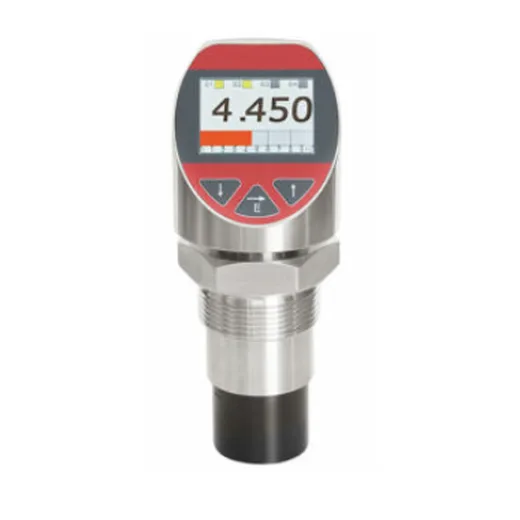
- Range
- 2, 5 or 8 m versions
- Accuracy
- ±2 mm or ±0.2% of set range
- Output
- 0/4 to 20 mA or 0 to 10 V, optional 2 or 4 PNP switch outputs
- Process
- -40 to +85 °C, -0.3 to +2 bar
- Protection
- IP65 / IP67, PVDF sensor
- Supply
- 9 to 30 V DC (14 to 30 V DC with 0 to 10 V)
Tanks, bunkers and silos, water and wastewater, and flow in open channels and over weirs. Optional Bluetooth and data logger.
USG2 + USF remote ultrasonicACS Sonicont · Separate sensor and wall-mount transmitter
The passive USG2 sensor sits on the vessel or channel. The USF transmitter and display mount where operators can reach them, up to 300 m away.
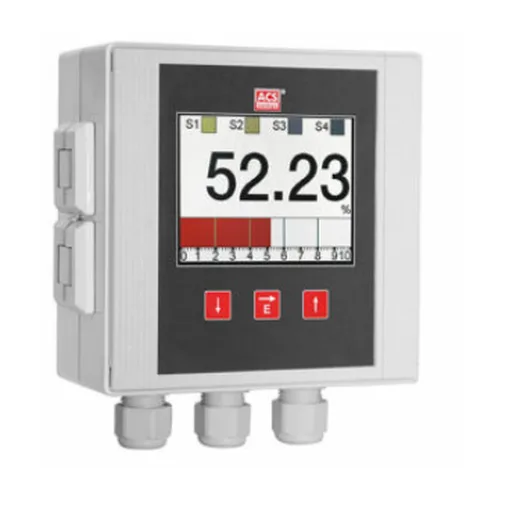
- Range
- Up to 25 m in liquids, 12 m in solids (USG2 250)
- Accuracy
- ±2 mm or ±0.2%
- Sensor
- PVDF, -40 to +85 °C, IP68 (cable version), ATEX Ex ia option
- Output
- 0/4 to 20 mA or 0 to 10 V, up to 4 relays
- Distance
- Sensor up to 300 m from the transmitter
- Supply
- 18 to 30 V DC or 186 to 253 V AC
Sumps and tanks in hot, wet or hard-to-reach positions, hazardous areas, open channel flow and pump control.
ULM-53 / ULM-70 ultrasonic level meterDinel · Two-wire ultrasonic level meters
Ultrasonic level meters whose 4 to 20 mA versions run on the signal loop itself, with a flanged version for longer ranges.
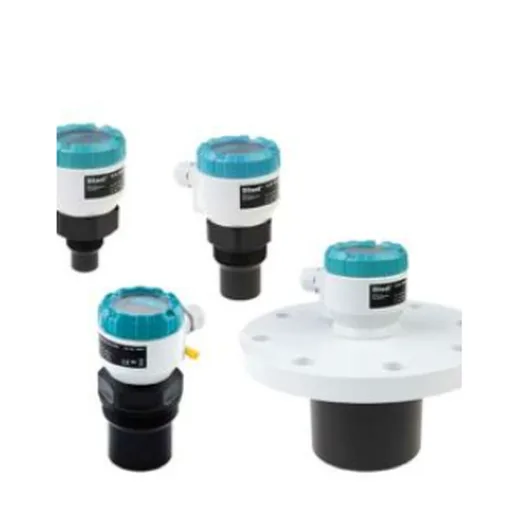
- Range
- ULM-53: up to 10 m · ULM-70: up to 20 m
- Accuracy
- 0.15% (ULM-70)
- Output
- 2-wire 4 to 20 mA, 0 to 10 V (ULM-53), HART (ULM-70), Modbus versions
- Process
- Up to 0.1 MPa
- Protection
- IP67, Ex ia versions
- Supply
- Loop powered in the 4 to 20 mA versions, 18 to 36 V DC (ULM-70)
Liquids, wastewater and sludge in tanks, sumps and open channels, and solids at reduced range.
120 GHz radar level transmitter with BluetoothAllpronix · FMCW radar with Bluetooth app set-up
High-frequency radar with a lens antenna and a narrow beam, set up from a phone over Bluetooth. Built for dusty silos, agitated vessels and long ranges.
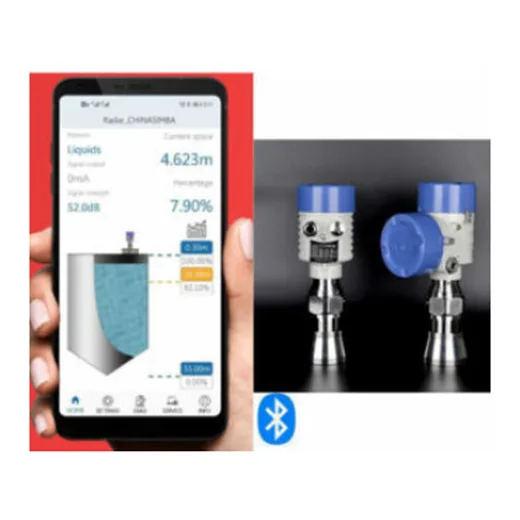
- Frequency
- 120 GHz FMCW, 10 GHz sweep
- Range
- 50, 100 or 150 m, beam about 1°
- Output
- 4 to 20 mA HART, Modbus RS485 optional
- Set-up
- Bluetooth app, PC or local keys
- Process
- -40 to +130 °C standard
- Protection
- IP67, aluminium housing
Cement, limestone and other dusty silos, reactors with agitators, sticky or condensing applications, and tall vessels.
High-temperature microwave level meterWADECO · MICRO-RANGER series
An FMCW microwave level meter for the hottest vessels on site. The heat-resistant antenna works in the hot zone without cooling, and the controller sits remotely.
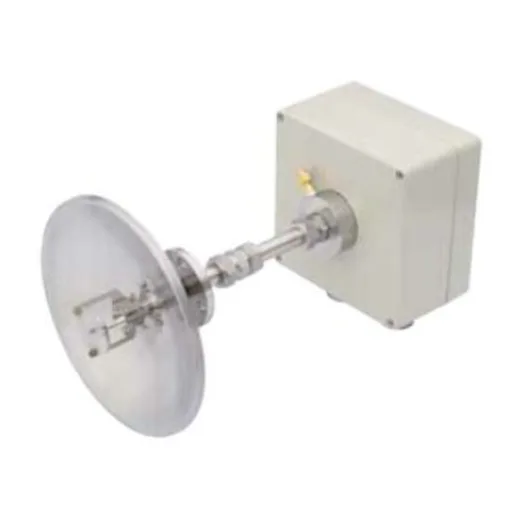
- Principle
- FMCW microwave, about 10 GHz (MWS-10RF)
- Range
- Up to 50 m
- Accuracy
- ±0.1% FS or ±10 mm
- Output
- 4 to 20 mA, RS-422 I/O, RS-232C to PC
- Antenna
- Parabolic or horn, no cooling needed
- Supply
- 90 to 240 V AC
Blast furnaces, converters, ladles and waste incinerators.
CLM-36 capacitance level sensorDinel · Rod and rope capacitive level sensors
Continuous capacitive level measurement with rod or rope probes, for liquids, bulk solids and powders, including high-temperature duty.
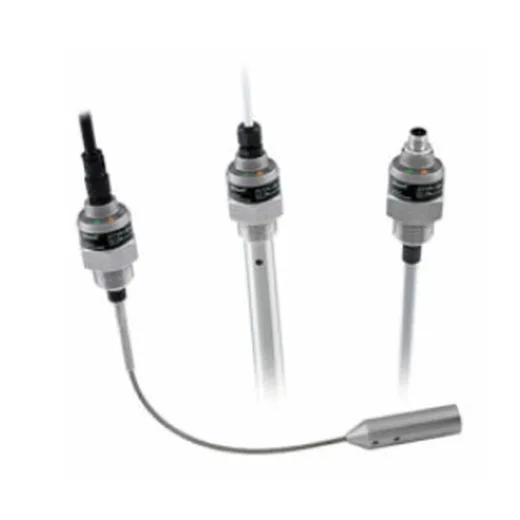
- Probe length
- Rod 0.2 to 5 m · rope 1 to 20 m
- Linearity
- Max 1%
- Output
- 4 to 20 mA or 0 to 10 V
- Process
- Up to +300 °C (uncoated rod); up to 7 MPa at 30 °C
- Protection
- IP67, Ex ia IIB version
- Supply
- 9 to 36 V DC (4 to 20 mA)
Liquids, bulk solids and powders in tanks, silos, hoppers and sumps.
FLD-32 Flexi Watch thru-wall level sensorDinel · Capacitive switch mounted outside the tank
A flexible switch that sticks to the outside of a plastic or glass vessel and detects the liquid through the wall. Nothing enters the tank.
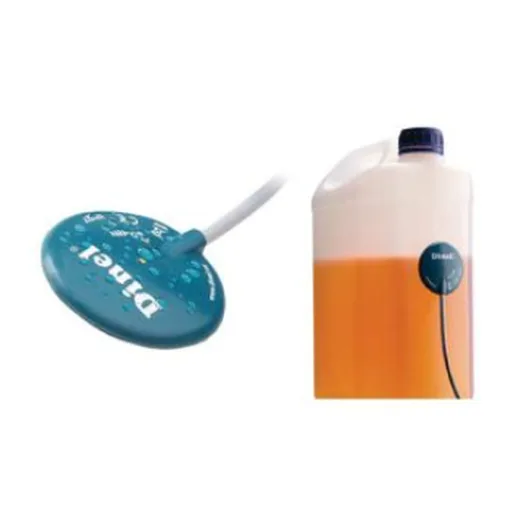
- Principle
- Capacitive, through the wall
- Wall
- Up to 8 mm conductive, 3 mm non-conductive liquids
- Output
- Electronic switch, 2-wire (M version)
- Supply
- 6 to 30 V DC
- Ambient
- -20 to +70 °C
- Mounting
- Self-adhesive or band, IP67
Water, diesel, oil and coolants in plastic tanks, tubs and canisters.
HLM-25N hydrostatic level probeDinel · Submersible pressure level probe
A submersible probe that measures level from the pressure of the liquid above it, with a 316L body and a vented cable.
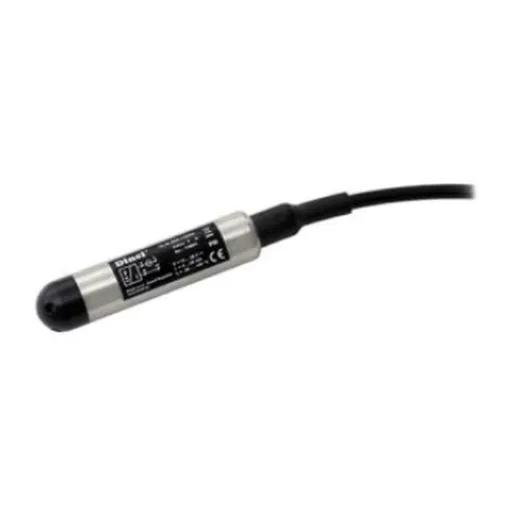
- Range
- 1 to 100 m H₂O standard, up to 200 m
- Output
- 4 to 20 mA or 0 to 10 V
- Body
- 316L stainless, Hastelloy C-276 membrane
- Cable
- PU with vent capillary
- Protection
- IP68
- Supply
- 10 to 30 V DC (4 to 20 mA)
Water in boreholes, wells, sumps and reservoirs.
Compare the range
Swipe the table sideways on a phone.
| Instrument | Principle | Range | Output | Supply | Protection |
|---|---|---|---|---|---|
| Ultrasonic | |||||
| ACS Sonicont USN integral ultrasonic | Ultrasonic | 2, 5 or 8 m | 4 to 20 mA or 0 to 10 V | 9 to 30 V DC (mA) | IP65 / IP67 |
| ACS Sonicont USG2 + USF remote ultrasonic | Ultrasonic | Up to 25 m | 4 to 20 mA, up to 4 relays | DC or AC | Sensor IP68 (cable), Ex ia option |
| Dinel ULM-53 / ULM-70 ultrasonic level meter | Ultrasonic | Up to 20 m | 2-wire 4 to 20 mA, HART | Loop powered (mA versions) | IP67, Ex ia versions |
| Radar | |||||
| Allpronix 120 GHz radar level transmitter with Bluetooth | Radar, 120 GHz | Up to 150 m | 4 to 20 mA HART | DC or AC versions | IP67 |
| WADECO High-temperature microwave level meter | Microwave, FMCW | Up to 50 m | 4 to 20 mA, RS-422 | 90 to 240 V AC | Antenna without cooling |
| Capacitance | |||||
| Dinel CLM-36 capacitance level sensor | Capacitance | Rod 5 m, rope 20 m | 4 to 20 mA or 0 to 10 V | 9 to 36 V DC (mA) | IP67, Ex ia IIB version |
| Dinel FLD-32 Flexi Watch thru-wall level sensor | Capacitance, point | Switch point | 2-wire switch | 6 to 30 V DC | IP67 |
| Hydrostatic | |||||
| Dinel HLM-25N hydrostatic level probe | Hydrostatic | Up to 200 m H₂O | 4 to 20 mA or 0 to 10 V | 10 to 30 V DC | IP68 |
What to tell us so we can recommend an instrument
Send us the material, vessel or chute details, process conditions and required output, and our team will recommend a suitable level instrument.
From selection to a working signal in your control system
A level instrument is only as useful as the signal that reaches the control room. We handle the steps around the instrument as well as the instrument itself.
We check the material, vessel, mounting position and output before recommending a unit.
Instruments from the brands on this page, with datasheets for your engineering file.
Mechanical mounting, cabling and termination by our E&I team.
Signal wiring and configuration into your PLC or SCADA.
Frequently asked questions
What is the difference between radar and ultrasonic level measurement?
Ultrasonic transmitters time a sound pulse to the surface and back. Radar transmitters do the same with a microwave signal. Radar is less affected by dust, vapour, temperature and pressure, while ultrasonic is often a practical choice for water, effluent and open channels.
Why choose 120 GHz radar over lower frequency radar?
A higher frequency gives a narrower beam from a smaller antenna. That helps the signal avoid vessel walls, ladders and agitators, and suits tall, narrow or dusty silos.
Can level be measured in a furnace or other very hot vessel?
Yes. The WADECO MICRO-RANGER microwave level meter is used on blast furnaces, converters, ladles and incinerators. The antenna sits in the hot zone without special cooling, and the controller mounts in a room-temperature area.
Why mount the ultrasonic electronics remotely?
A separate transmitter lets the sensor sit in a hot, wet or hard-to-reach position while the display and settings stay at eye level. With the Sonicont USG2 and USF, the sensor can be up to 300 m from the transmitter.
When is a hydrostatic probe the better choice?
When the surface is foamy or turbulent, or the vessel is a borehole, well or deep sump. A submersible probe measures the pressure of the liquid above it instead of looking at the surface.
Can level be detected through the wall of a tank?
Yes, on plastic and glass vessels. The Dinel FLD-32 thru-wall level sensor mounts on the outside and detects liquid through walls up to 8 mm thick for conductive liquids and 3 mm for non-conductive liquids.
Can ultrasonic level transmitters measure open channel flow?
Yes. The transmitter measures the water level in a flume or over a weir and converts it to flow using the flume or weir curve.
Can Proplant PCE help me choose the right level instrument?
Yes. Send us the material, vessel or chute details, process conditions and required output, and our team will recommend a suitable instrument.
Do these instruments connect to a PLC or SCADA?
Yes. Depending on the model, outputs include 4 to 20 mA, HART, RS-485 Modbus and relays. Tell us what your control system accepts and we will match the output.
Let's discuss your level application
Tell us what you are measuring, where the instrument will sit and what the signal needs to do. We will come back with a recommendation and the datasheet.