
Industrial temperature measurement for process, plant and buildings
Temperature switches, head-mount and DIN rail transmitters, compact connector transmitters and wireless temperature and humidity monitoring. Selected for the sensor, the process and the control system they report to, then supplied, configured and integrated by Proplant PCE.
Temperature readings you can control the plant with
Temperature directly influences product quality, energy efficiency, and process stability. A reading that drifts or drops out can spoil a batch, waste energy on overheating, or let a bearing, motor or hydraulic unit run hot until it trips.
The sensor type, where it sits, cable length, electrical noise and the range set on the signal all affect how a temperature measurement behaves. Whether you use an RTD or a thermocouple, we match the transmitter or switch to the process and to the control system that reads it.
What will the 4 to 20 mA signal read?
Set the range on the transmitter, then move the temperature or type the current your PLC sees. The calculator scales it the way a linear transmitter does.
12.00 mA
50.0 % of the set range, from 0 to 150 °C.
- 4 to 20 mA: the set range
- 3.8 to 4 and 20 to 20.5 mA: just outside the range
- 3.6 mA or less, 21 mA or more: sensor or loop fault
Limits follow the NAMUR NE43 recommendation used by the NOVUS transmitters on this page. Other transmitters may use slightly different fault levels, so check its settings.
Sensors, transmitters, switches and wireless
Pick one to see how it works, where it fits, what to check, and which instruments in our range use it.
- How it works
- A platinum resistance thermometer changes resistance with temperature. The transmitter passes a small current through it and converts the resistance into temperature.
- Typically used for
- Process lines, tanks, bearings and rooms where good accuracy and stability matter, up to a few hundred degrees.
- Check before you choose
- The number of wires (2, 3 or 4) affects lead resistance error. Check the range, the accuracy class and the sensor tube length.
- How it works
- Two different metals joined at the tip produce a small voltage that depends on the temperature difference to the cold junction. The transmitter measures that voltage and compensates for the cold junction.
- Typically used for
- High temperatures, furnaces, kilns, exhausts and fast-changing processes.
- Check before you choose
- The thermocouple type sets the range, and extension cable must match the type. Isolation helps where a grounded junction meets a noisy plant earth.
- How it works
- A head-mount, connector or DIN rail transmitter turns the sensor signal into a 4 to 20 mA loop signal scaled to the range you set, so the reading survives long cable runs to the PLC.
- Typically used for
- Any RTD or thermocouple that reports to a PLC, DCS or SCADA.
- Check before you choose
- Mounting (head, connector or rail), the range to scale to, sensor failure behaviour and whether the loop needs isolation.
- How it works
- A temperature switch measures the temperature and switches an output when it crosses a set point, often with a local display and an analogue signal as well.
- Typically used for
- Machine protection, heater and cooler control, and alarms that act without waiting for the PLC.
- Check before you choose
- Switch points and hysteresis, output type (PNP or relay), process connection and pressure rating.
- In our range
- ACS Thermocont TS4S Temperature Switch
- How it works
- A battery or mains powered transmitter measures temperature and humidity and sends the readings over a wireless link to a gateway connected to the control system.
- Typically used for
- Rooms, stores and buildings where running signal cable is impractical.
- Check before you choose
- Distance and obstructions between transmitter and gateway, battery life, and the protocol your system reads.
Six temperature instruments
Filter by type, open a product for its full specification sheet, or download the manufacturer's brochure.
 ACS-Control-System · Temperature switch
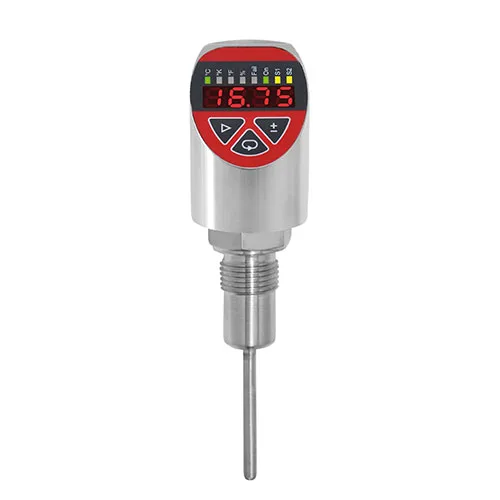
ACS Thermocont TS4S Temperature Switch
An all-in-one electronic temperature switch with a bright LED display, two PNP switch outputs and an optional 4 to 20 mA signal, for monitoring, control and continuous measurement in gases, vapours, liquids and dusts.
- -99.9 to +500 °CMeasuring range
- ≤ 100 barProcess pressure
- 2x PNP + 4 to 20 mAOutputs
- Datexel · Head-mount, isolated
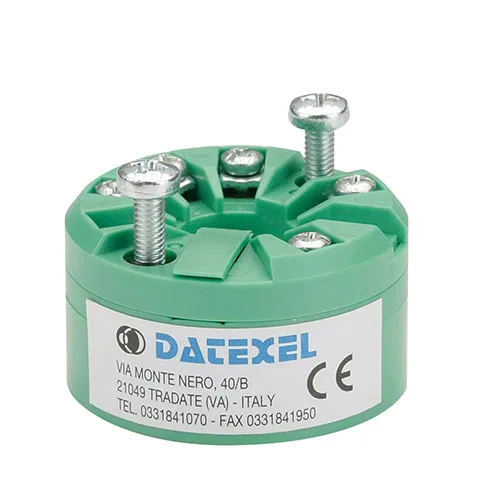
Datexel DAT 1066 Head-Mount Temperature Transmitter
An isolated two-wire universal transmitter that fits in a DIN B sensor head and turns RTD, thermocouple, mV, resistance or potentiometer signals into a 4 to 20 mA loop signal, configured from a PC.
- 1500 VacIsolation
- ±0.1 % f.s.RTD linearity
- 7 to 32 VdcLoop supply
- NOVUS · Head-mount or DIN rail
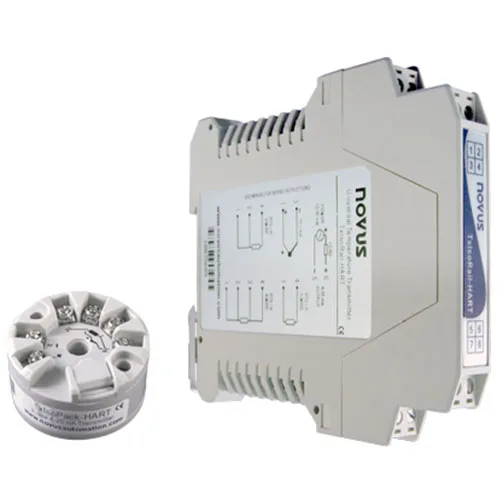
NOVUS TxBlock-USB and TxRail-USB Temperature Transmitters
High-precision temperature transmitters with a universal input and a USB port for configuration, calibration and online monitoring: TxBlock-USB for the sensor head and TxRail-USB for the DIN rail.
- 0.1 % of spanTypical accuracy
- 4 to 20 mA / 0 to 10 VOutput
- 8 to 35 VdcSupply
- NOVUS · Head-mount, isolated
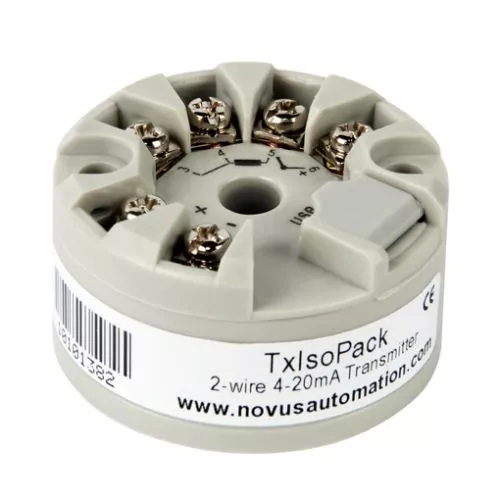
NOVUS TxIsoPack-USB Isolated Temperature Transmitter
A fully isolated, two-wire, loop-powered temperature transmitter for the sensor head.
- 1000 VacIsolation
- 0.2 %Accuracy
- 12 to 35 VdcSupply
- NOVUS · Compact, connector mount
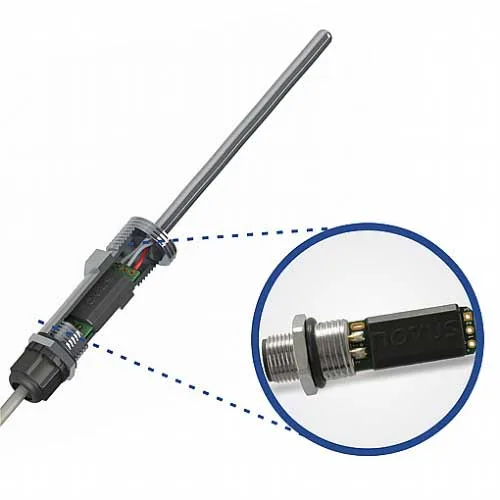
NOVUS TxMini Compact Temperature Transmitter
A smart Pt100 or Pt1000 temperature transmitter small enough for tight spaces, with a 4 to 20 mA output on the two-wire loop and USB set-up without a power supply.
- 0.1 % of spanAccuracy
- Pt100 / Pt1000Input
- 8 to 35 VdcSupply
- NOVUS · Wireless, temperature and humidity
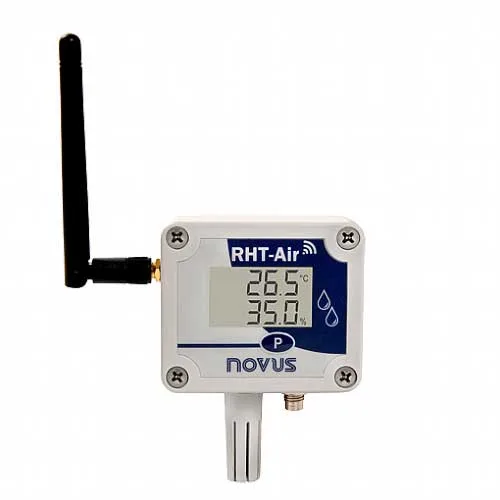
NOVUS RHT-Air Wireless Temperature and Humidity Transmitter
A wireless temperature and relative humidity transmitter with a local display.
- ±1 °CTemperature accuracy
- ±3 % RHHumidity accuracy
- 500 mWireless range
Compare the range
Swipe the table sideways on a phone. Tap a name to open its page.
| Instrument | Type | Input | Output | Supply | Mounting |
|---|---|---|---|---|---|
| ACS Thermocont TS4S Temperature Switch | Temperature switch | Pt100 class A, built in | 2x PNP switch, 4 to 20 mA option | 10.5 to 35 VDC | G½" or G¼" thread, compression fitting |
| Datexel DAT 1066 Head-Mount Temperature Transmitter | Head-mount transmitter, isolated | RTD, thermocouple, mV, resistance | 4 to 20 mA | 7 to 32 Vdc | DIN B head, DIN rail kit |
| NOVUS TxBlock-USB and TxRail-USB Temperature Transmitters | Head-mount or DIN rail transmitter | Thermocouple, Pt100, Pt1000, NTC, mV | 4 to 20 mA; 0 to 10 V on TxRail-USB | 8 to 35 Vdc (TxBlock-USB) | Sensor head or DIN rail |
| NOVUS TxIsoPack-USB Isolated Temperature Transmitter | Head-mount transmitter, isolated | Pt100, thermocouple, mV | 4 to 20 mA or 20 to 4 mA | 12 to 35 Vdc | Sensor head |
| NOVUS TxMini Compact Temperature Transmitter | Compact transmitter | Pt100 or Pt1000, 3-wire | 4 to 20 mA | 8 to 35 Vdc | M12 or DIN 43650 connector |
| NOVUS RHT-Air Wireless Temperature and Humidity Transmitter | Wireless transmitter | Built-in temperature and humidity sensors | Wireless to AirGate-Modbus | Battery or 10 to 35 Vdc | Wall mount or probe extension |
What to tell us so we can recommend an instrument
Send us the process, sensor, mounting and the output you need, and our team will recommend a suitable temperature instrument.
From Selection to a Working Signal in Your Control System
A temperature reading is only as useful as the signal that reaches the control room. Proplant PCE handles the steps around the instrument as well as the instrument itself.
Application review
We check the process temperature, sensor type, mounting and the signal your control system needs before recommending a transmitter.
Supply
Transmitters, switches and sensors from the brands on this page, with the brochure for your engineering file.
Configuration and installation
Range, sensor type and failure behaviour set before delivery, then mounting, cabling and termination by our E&I team.
Integration
Loop wiring and scaling in your PLC or SCADA, so the temperature on screen matches the process.
Frequently asked questions
What is the difference between an RTD and a thermocouple?
An RTD such as a Pt100 changes resistance with temperature and gives good accuracy and stability at moderate temperatures. A thermocouple produces a small voltage, covers much higher temperatures and responds quickly, but is usually less accurate.
Why use a temperature transmitter instead of wiring the sensor straight to the PLC?
A transmitter converts the small sensor signal into a 4 to 20 mA loop signal scaled to your range. The signal is far less affected by long cables and electrical noise, and a broken sensor can drive the output to a recognisable fault level.
What does 2, 3 or 4-wire mean for a Pt100?
It is the number of wires between the sensor and the transmitter. Extra wires let the transmitter cancel the resistance of the leads, so 3 and 4-wire connections are more accurate than 2-wire.
When do I need an isolated transmitter?
When ground loops or a noisy plant earth could disturb the signal, or where a grounded thermocouple meets the loop. The Datexel DAT 1066 and NOVUS TxIsoPack-USB both isolate the input from the loop.
Can a temperature transmitter be configured on site?
Yes. The NOVUS transmitters are configured over USB, and the Datexel DAT 1066 with PC software. We can also deliver them pre-configured for your sensor and range.
Do you supply wireless temperature monitoring?
Yes. The NOVUS RHT-Air sends temperature, humidity and dew point to an AirGate-Modbus gateway, typically up to 100 m indoors and 500 m in open field.
Can Proplant PCE help me choose the right temperature transmitter?
Yes. Send us the sensor type, temperature range, mounting and the output your control system needs, and our team will recommend a suitable instrument.
Do these instruments connect to a PLC or SCADA?
Yes. Depending on the model, outputs include 4 to 20 mA, 0 to 10 V, PNP switch outputs and Modbus through a wireless gateway. Tell us what your control system accepts and we will match the output.
Let's Discuss Your Temperature Application
Tell us what you are measuring, where the sensor sits and what the signal needs to do. We will come back with a recommendation and the brochure.