
Coriolis Mass Flow Meter
A direct mass flow meter that also measures density and temperature, with triangular, U-type and straight-tube sensors from DN3 to DN150 for liquids, slurries and gases.
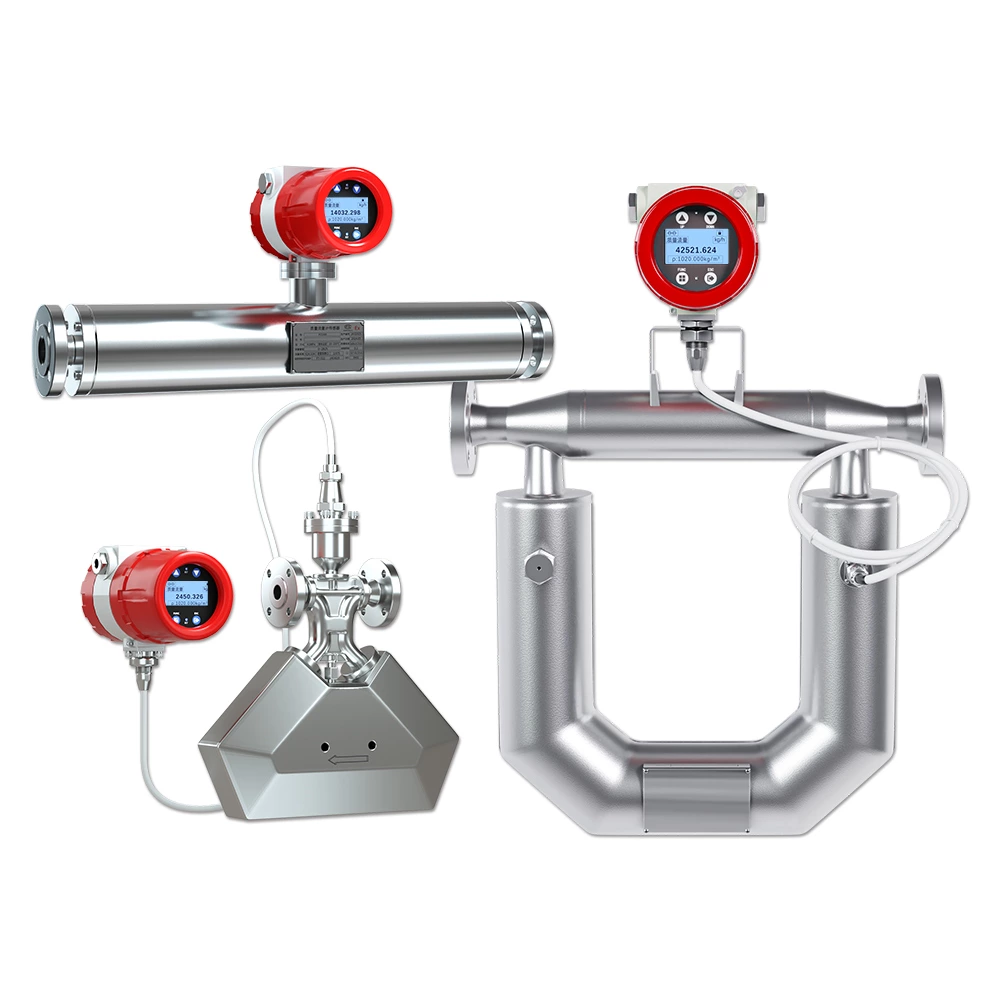
Key Features of the Coriolis Mass Flow Meter
Mass flow without compensation
The Coriolis effect is proportional to mass flow, so the reading needs no temperature, pressure or density correction.
Flow accuracy class 0.2 or 0.5.
Density measurement
Density from 0.3 to 3.000 g/cm³ with ±0.002 g/cm³ accuracy, from the natural frequency of the vibrating tubes.
Temperature measurement
A temperature sensor on the tubes measures to ±1 °C and is available as an output.
Three sensor shapes
Triangular DN3 to DN15, U-type DN10 to DN150 and straight tube DN8 to DN80, in conventional, sanitary and high-pressure versions.
No straight run needed
No upstream or downstream straight pipe is required, and there are no moving parts in the flow.
Outputs for the control system
Two 4 to 20 mA outputs, a pulse or frequency output and RS485 Modbus RTU, with HART optional.
Coriolis Mass Flow Meter Technical Specifications
Tap a group to filter the Coriolis mass flow meter specifications, or show them all.
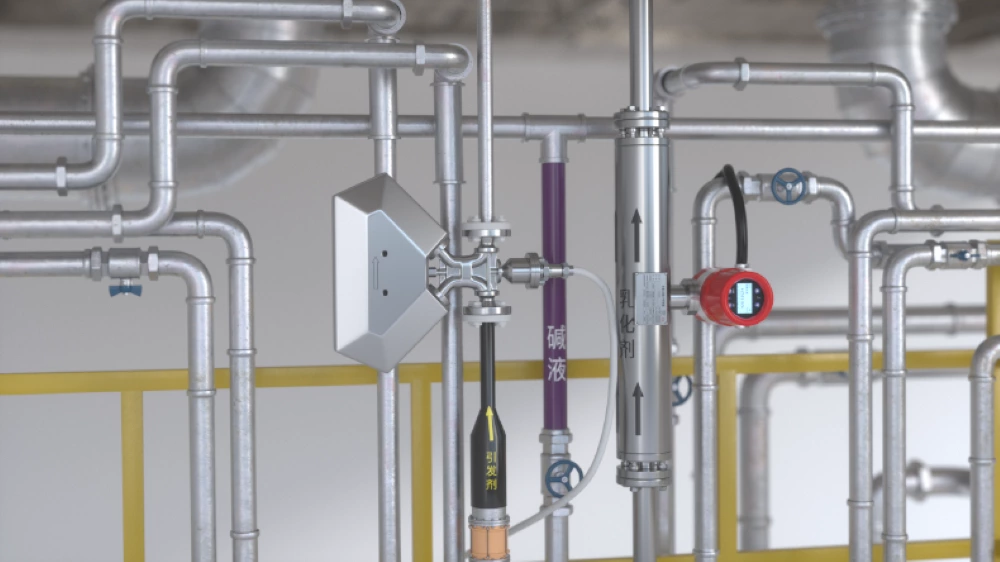
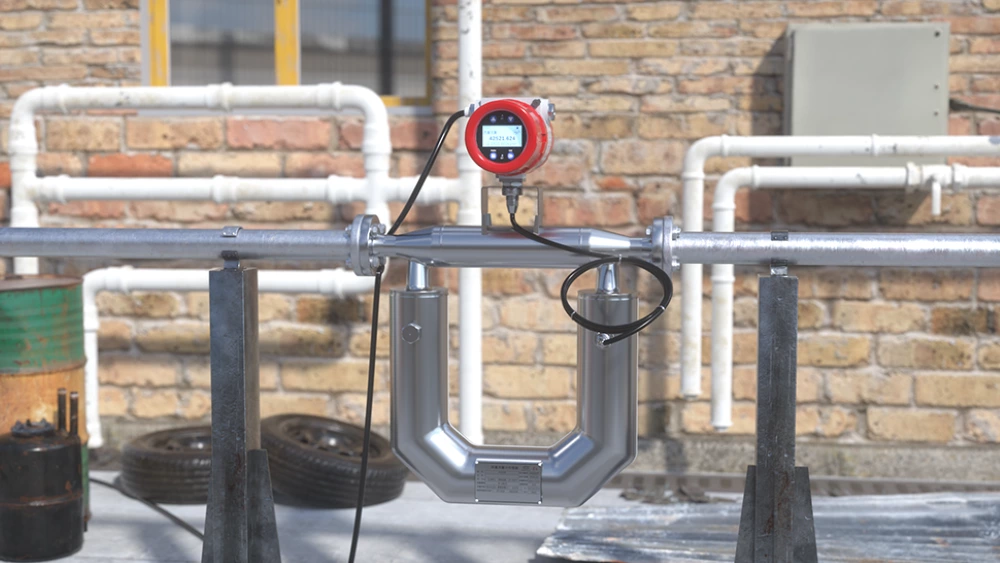
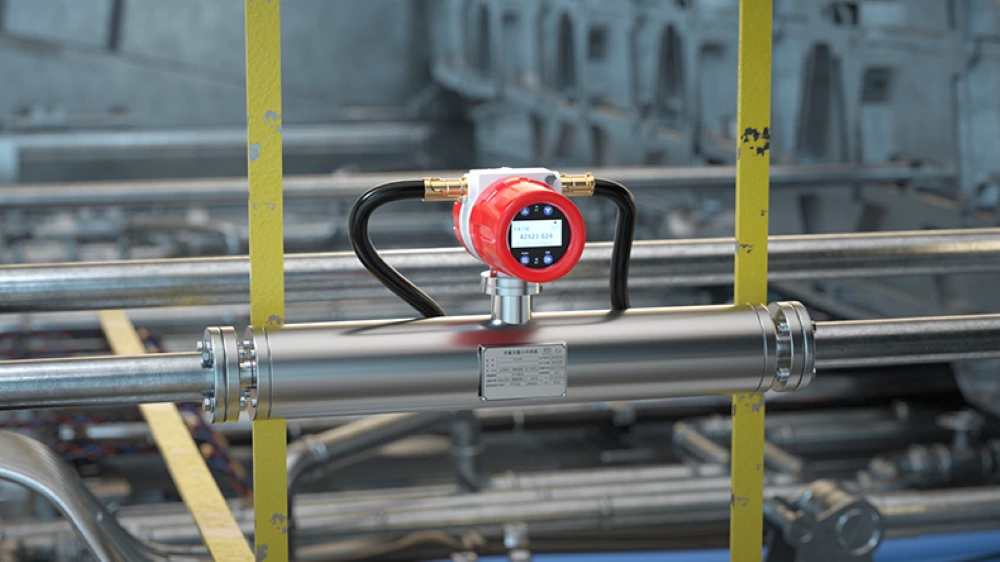
- 0.2%Mass flow accuracy0.5% class also available
- ±0.002 g/cm³Density accuracy
- DN3 to DN150Sizesthree sensor shapes
- IP67Protection
| Specification | Details |
|---|---|
| Measured variables | Mass flow, density and temperature; volume flow calculated |
| Flow accuracy | Class 0.2 or 0.5; repeatability half of the measurement error |
| Density | 0.3 to 3.000 g/cm³, accuracy ±0.002 g/cm³ |
| Temperature | Accuracy ±1 °C |
| Flow ranges (standard) | DN3: 0 to 96 kg/h; DN15: 0 to 3,000 kg/h; DN25: 0 to 9,600 kg/h; DN50: 0 to 48,000 kg/h; DN80: 0 to 120,000 kg/h; DN150: 0 to 360,000 kg/h |
| Analogue outputs | 2 × 4 to 20 mA, load 250 to 600 Ω |
| Digital and pulse | RS485 Modbus RTU; HART optional; pulse/frequency output, 50% duty cycle |
| Sensor shapes and sizes | Triangular DN3 to DN15; U-type DN10 to DN150; straight tube DN8 to DN80 |
| Medium temperature | Standard -50 to +200 °C; high-temperature -50 to +350 °C; low-temperature -200 to +200 °C |
| Pressure loss | 100 kPa at maximum flow (water) |
| Materials | Measuring tube 316 stainless steel; body 304 stainless steel; aluminium alloy converter housing |
| Process connection | Flanges to HG/T 20592 or clamps to ISO 2852 |
| Installation | No straight upstream or downstream run required; remote transmitter cable up to 100 m |
| Supply | 24 V DC or 220 V AC, max. 15 W |
| Protection | IP67; ambient -40 to +60 °C |
Figures from the FCC300 Coriolis mass flow meter datasheet. Confirm the sensor shape, size and options for your application before ordering.
Download Data SheetHow does a Coriolis mass flow meter work?
Step by step:
With no flow, the inlet and outlet of the tubes move in step. Flow adds a twist, so the outlet lags the inlet. That time shift is proportional to mass flow, and a denser product lowers the frequency the tubes vibrate at.
Where Coriolis meters are used
Typical applications for Coriolis mass flow measurement.
- 01Custody transferProduct bought and sold by mass, such as fuels, chemicals and food ingredients.
- 02Batching and blendingAccurate dosing of additives, resins and ingredients by mass.
- 03Oil, gas and chemicalsOils, solvents and other non-conductive liquids that magnetic meters cannot measure.
- 04Food and pharmaceuticalSanitary straight-tube versions with clamp connections for hygienic lines.
How the Coriolis meter compares
The highlighted row is this instrument. Tap any other name to open its page.
| Instrument | Principle | Range | Output | Supply | Protection |
|---|---|---|---|---|---|
| Electromagnetic | |||||
| ALLMAG 4000 electromagnetic flow meter | Electromagnetic | DN10 to DN2000, up to 15 m/s | 4 to 20 mA, pulse, RS485, HART | 100 to 240 V AC or 24 V DC | IP65 compact, IP68 remote |
| ALLMAG 5000 IO-Link electromagnetic flow meter | Electromagnetic | 0.01 l/min (G¼) to DN100 flanged | IO-Link, 4 to 20 mA, pulse, switch | 19 to 30 V DC | IP67 |
| Coriolis | |||||
| Coriolis mass flow meter | Coriolis | DN3 to DN150, up to 360 t/h | 2 × 4 to 20 mA, pulse, Modbus, HART | 24 V DC or 220 V AC | IP67 |
| Flow sensor | |||||
| ALL-005 programmable thermal flow sensor | Thermal (calorimetric) | 0.04 to 3 m/s liquids, 2 to 100 m/s air | 2 × switch, 4 to 20 mA, IO-Link | 18 to 30 V DC | IP65 / IP67 |
| Differential pressure | |||||
| Itabar and deltaflow pitot flow tubes | Differential pressure | DN40 up to DN12000 | Via the DP transmitter | Passive sensor | Stainless steel, up to 400 °C (IBF) |
From Selection to a Working Signal in Your Control System
A flow meter is only as useful as the signal that reaches the control room. Proplant PCE handles the steps around the instrument as well as the instrument itself.
Application review
We check the liquid or gas, pipe size, flow range, process conditions and output before recommending a meter.
Supply
Instruments from the brands on this page, with datasheets and calibration certificates for your engineering file.
Installation
Mechanical installation, earthing, cabling and termination by our E&I team.
Integration
Signal wiring and configuration into your PLC or SCADA, including Siemens systems.
What to tell us so we can recommend an instrument
Tick off what you already know. We will check the Coriolis meter against your conditions, or suggest a better fit from our range.
Other flow instruments to consider
Coriolis Mass Flow Meter FAQ
What does a Coriolis meter measure?
Mass flow directly, plus density and temperature. Volume flow is calculated from the mass flow and density.
When should I choose Coriolis over a magnetic flow meter?
When the liquid is not conductive, such as oils and solvents, when you need mass rather than volume, or when density is needed as well as flow.
Which sensor shape should I choose?
Triangular tubes suit small flows from DN3 to DN15, U-type tubes cover DN10 to DN150, and straight tubes from DN8 to DN80 drain fully and are easy to clean.
Does it need straight pipe?
No straight upstream or downstream run is required. Mount the sensor free of strain and vibration and keep it full.
What outputs are available?
Two 4 to 20 mA outputs, a pulse or frequency output and RS485 Modbus RTU, with HART as an option.
Can Proplant PCE size a Coriolis meter for me?
Yes. Send us the product, flow range, pressure, temperature and accuracy you need and we will recommend the sensor shape and size.
Let's Discuss Your Flow Application
Tell us what is flowing, the pipe it flows in and what the signal needs to do. We will come back with a recommendation and the datasheet.