
Datexel DAT 4135 Isolated Universal Signal Converter
An isolated universal signal converter that measures and linearises RTD, thermocouple, resistance, current, voltage and potentiometer signals and turns them into a current or voltage output.
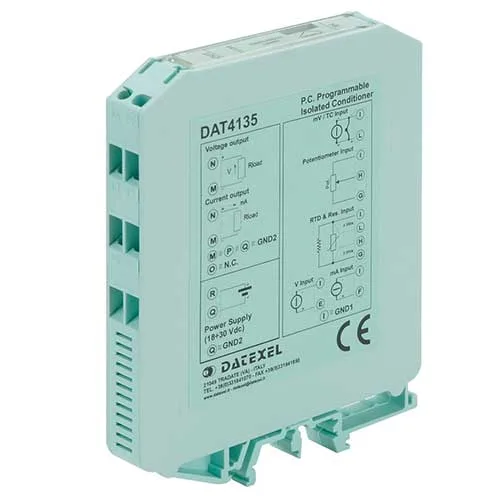
Key Features of the Datexel DAT 4135
Universal input
RTD, thermocouple, mV, V, mA, resistance and potentiometer, configurable.
Configurable output
Current or voltage output, set during configuration.
Linearisation
Linearity TC ±0.2 % of full scale and RTD ±0.1 % of full scale.
Isolation
2000 Vac, 50 Hz for 1 minute, input and supply to output.
PC configuration
PROSOFT software through the PRODAT interface.
Slim DIN rail housing
12.5 mm thick, about 90 g, on EN 50022 or EN 50035 DIN rail.
Datexel DAT 4135 Technical Specifications
Tap a group to filter the universal signal converter specifications, or show them all.
- 2000 VacIsolation1 min
- ±0.1 %RTD linearityof full scale
- 18 to 30 VdcSupply
- -20 to +70 °COperating temperature
| Specification | Details |
|---|---|
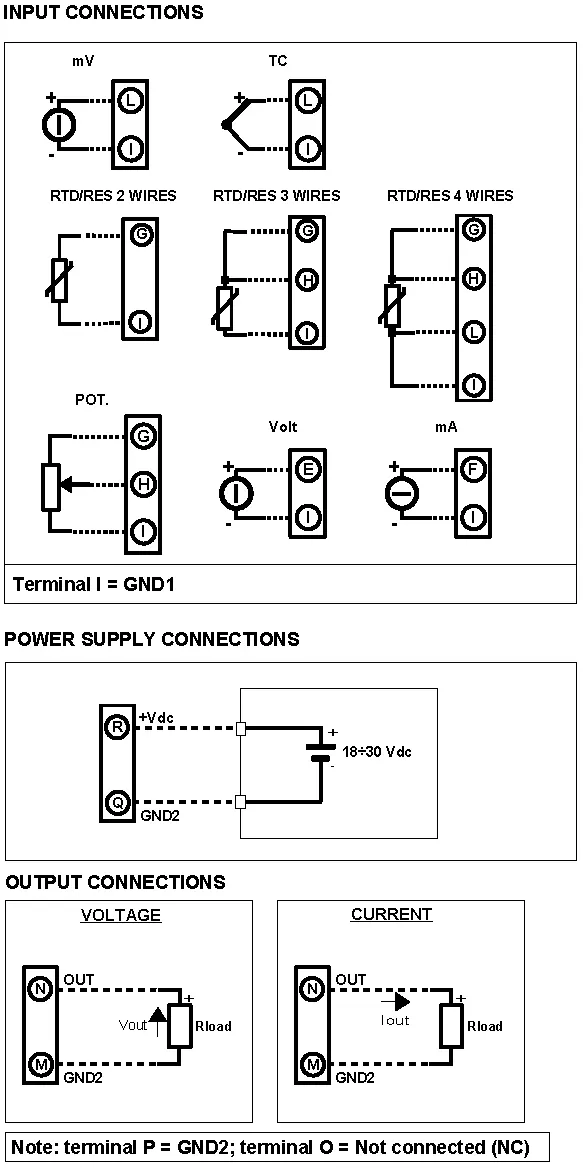
| Inputs | RTD, TC, mV, V, mA, resistance, potentiometer (configurable) |
| Accuracy | Linearity TC ±0.2 % f.s., RTD ±0.1 % f.s.; thermal drift ±0.01 % / °C |
| Output | Configurable current or voltage |
| Output calibration | Current ±7 µA; voltage ±5 mV |
| Configuration | PROSOFT through the PRODAT interface |
| Mounting | DIN rail, EN 50022 and EN 50035 |
| Weight | About 90 g; 12.5 mm thick |
| Power supply | 18 to 30 Vdc; reverse polarity protection 60 Vdc max. |
| Isolation | 2000 Vac, 50 Hz, 1 min (input and supply to output) |
| Operating temperature | -20 to +70 °C |
| EMC and marking | CE; EN 61000-6-2, EN 61000-6-4 |
Figures from the Datexel brochure. Confirm the version and options for your application before ordering.
Download BrochureHow does the Datexel DAT 4135 work?
Tap a step, or let it run, to follow the signal from the field to the control system.
Step by step:
The DAT 4135 takes almost any sensor or signal and gives the PLC the standard current or voltage it expects, with isolation in between to keep the two circuits apart.
Where the Datexel DAT 4135 is used
Typical uses for this universal signal converter, based on what it does.
- 01Sensor to PLC conversionRTDs and thermocouples converted to a standard signal in the panel.
- 02Voltage to currentChanging a voltage signal into a current, or the reverse.
- 03Isolating signalsSeparating field and control circuits.
How the Datexel DAT 4135 compares
Other signal converters and isolators in our range. The highlighted row is this product. Tap any other name to open its page.
| Product | Type | Signals | Outputs and communication | Supply | Mounting |
|---|---|---|---|---|---|
| Acromag BusWorks XT1540 Ethernet I/O Module | Ethernet I/O | 4 discrete I/O | 8 analogue out; Modbus TCP, EtherNet/IP or PROFINET | 12 to 32 V DC | DIN rail, 22.5 mm |
| Acromag 961EN and 962EN Analogue Input Ethernet I/O | Ethernet I/O | 6 differential current or voltage inputs | Modbus TCP or EtherNet/IP | 15 to 36 V DC | DIN rail |
| Acromag 981EN, 982EN and 983EN Discrete Ethernet I/O | Ethernet I/O | 12 discrete inputs, outputs or both | Modbus TCP or EtherNet/IP | 15 to 36 V DC | DIN rail |
| Datexel DAT 511 Loop-Powered Current Isolator | Loop isolator | 0 to 20 mA | Isolated 0 to 20 mA | Loop powered | DIN rail, 17 mm |
| Datexel DAT 4135 Isolated Universal Signal Converter | Universal converter | RTD, TC, mV, V, mA, resistance | Isolated current or voltage | 18 to 30 Vdc | DIN rail |
| Datexel DAT 4035 Loop-Powered Universal Transmitter | Universal transmitter | RTD, TC, mV, V, mA, resistance | Isolated 4 to 20 mA loop | Loop powered, 10 to 32 Vdc | DIN rail |
From Selection to a Working Signal in Your Control System
A field signal is only as useful as the value that reaches the control room. Proplant PCE handles the configuration, panel work and integration around the device as well as the device itself.
Application review
We check the signals, channel count, network and mounting before recommending a device.
Supply
Instruments and modules from the brands on this page, with the brochure for your engineering file.
Configuration and installation
Ranges, alarms, addresses and network settings set up, then panel building, cabling and termination by our E&I team.
Integration
Mapping into your PLC, SCADA or historian, and testing until the value on screen matches the field.
What to tell us so we can recommend a device
Tick off what you already know. We will check the Datexel DAT 4135 against your application, or suggest a better fit from our range.
Other automation products to consider
Datexel DAT 4135 FAQ
What is the Datexel DAT 4135?
An isolated universal signal converter that linearises RTD, thermocouple, resistance, mV, V, mA and potentiometer inputs into a current or voltage output.
What supply does it need?
18 to 30 Vdc, with reverse polarity protection to 60 Vdc.
How much isolation does it give?
2000 Vac, 50 Hz for 1 minute between the input and supply and the output.
How is it configured?
With the Datexel PROSOFT software through the PRODAT interface.
How is it different from the DAT 4035?
The DAT 4135 is powered from 18 to 30 Vdc and gives a current or voltage output. The DAT 4035 is a two-wire, loop-powered transmitter with a 4 to 20 mA output.
Can Proplant PCE help me choose the right automation device?
Yes. Send us the signals, channel count, network and mounting, and our team will recommend a suitable device and set it up for your system.
Let's Discuss Your Automation Project
Tell us what signals you need to bring in, where the device sits and what system it reports to. We will come back with a recommendation and the brochure.